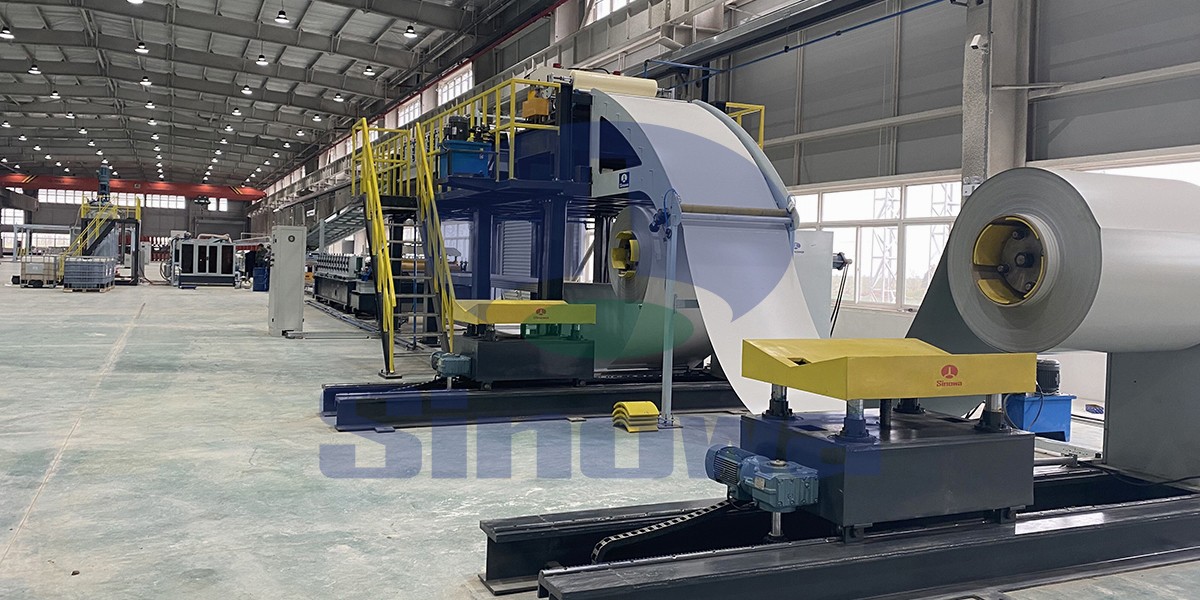
Polyurethane Sandwich Panel Machine
Sinowa is polyurethane sandwich panel machine manufacturer from china, dedicated to the research and development of high-end and high-efficiency, Sinowa is comprehensively taking the leading position in terms of efficiency, automation control level, HMI, environment protection and energy consumption, with subversive designs made in some critical technological fields to procure exceptional cost performance and customer-friendly experience for the entire polyurethane sandwich panel machine. The adoption of system integration technology and bus control technology accomplishes the full automatization of integrated and coordinated control of the entire polyurethane sandwich panel machine with accessible remote interactive communication. Ranking the first-class level in the world, it is currently the polyurethane sandwich panel machine in the market taking a comprehensive lead in high performance.
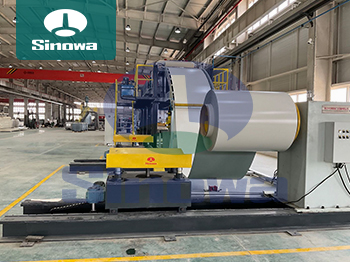
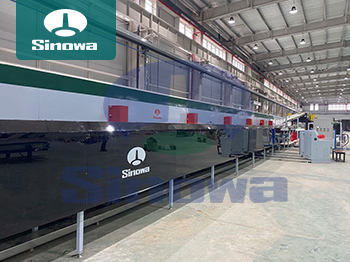
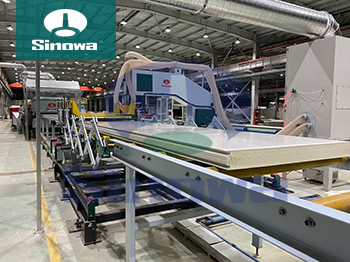
Based on the continuous technological pursuit, the polyurethane sandwich panel machine developed by Sinowa provides you with high-efficiency industrial value. Based on China's cost advantage and our hard-working technology concept, our polyurethane sandwich panel machine has a world-leading price-performance advantage. polyurethane sandwich panel machine can meet a variety of production needs of customers.The whole polyurethane sandwich panel machine design concept of modularization enables all our components to be integrated and combined at will. Our polyurethane sandwich panel machine can easily automate the production of roof sandwich panel, wall sandwich panel, cold storage sandwich panel and other products by different combination and configuration selection and siple switching. The inner core layer can be polyrethane or rock wool, glass wool, an so on.
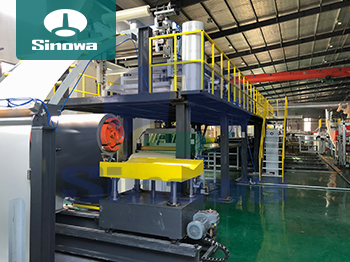


The polyurethane sandwich panel machine has high adaptability, which may produce various sandwich panel of the PU, PIR and rock wool systems. We may design various products according to the customer’s requirements, including various configurations, so as to meet their demands with flexible price system. Highly integrated and linked control system centralizes all control points at the main central center, achieving parameter linkage, fault self-diagnosis controlled by the whole line and shipping distance control. High-level automatic control system also saves the manpower and reduces the manpower loss for customers.


Concentrated system control is fully realized in the practice of concentrated process control so that the control system of all the movements of the parts in the polyurethane sandwich panel machine is integrated in one process control console with accessible remote communication to elevate the automation and reduce the allocated number of personnel for the assembly line. The main engine with modularized design achieves the precision operation of the polyurethane sandwich panel machine, stable and reliable quality, less part and maintenance loss. The whole polyurethane sandwich panel machine has over 40 innovative inventions, making our products have lots of unique features and the comprehensive performance of our polyurethane sandwich panel machine leading in the industry.


The precision servo hoisting mechanism employed by the main engine without hydraulic system makes the board thickness control flexible and the customer may conveniently change or adjust the board thickness. There will be not such troubles as hydraulic system adjustment, leakage, maintenance, etc. High-level energy saving and protection design makes the whole polyurethane sandwich panel machine possible to produce around the clock throughout the year and the customer will save huge budget. In addition, the isolated heat preservation room is constructed for warming the environment. The energy saving and protection design of our polyurethane sandwich panel machine may guarantee that the customer’s production line may be freely heated and produce in the main time to save more costs for customers.


The high-power low-consumption design quickens the reaction of the polyurethane sandwich panel machine while energy consumption is kept low. With the brand-new, fully sealed inner insulation design, the energy consumption is controlled at the minimum level to achieve the design objective of less than an hour for the insulation system to be activated from the room temperature above 5℃ to the production process temperature. The energy consumption is only 40% that of those similar products.
In the modern construction and manufacturing industries, the demand for efficient, durable, and energy-saving materials has driven the continuous innovation of production equipment. Among these, polyurethane sandwich panel machines stand out as critical infrastructure, enabling the mass production of composite panels that integrate thermal insulation, structural strength, and weather resistance. Polyurethane (PU) sandwich panels, consisting of a PU foam core bonded between two facing materials (such as metal sheets, glass fiber mats, or flexible films), have become indispensable in diverse fields ranging from industrial warehouses and cold storage facilities to prefabricated buildings and transportation vehicles.

1. Core Components of Polyurethane Sandwich Panel Machines
A standard polyurethane sandwich panel machine is a integrated production system composed of multiple functional modules, each playing a vital role in ensuring the quality, efficiency, and flexibility of panel production. These modules are designed to work in coordination, covering the entire process from raw material preparation to finished product packaging. The key components include unwinding and preprocessing units, mixing and metering systems, foaming and lamination sections, cooling and curing devices, cutting mechanisms, and control systems.
1.1 Unwinding and Preprocessing Units
The unwinding unit is the starting point of the production line, responsible for feeding the facing materials into the system. Depending on the type of facing material (rigid or flexible), the unit is equipped with single or double unwinders, which can handle coils of different widths and weights. For metal facing materials (e.g., steel or aluminum coils), the unwinding unit is often paired with a leveling mechanism to eliminate wrinkles and ensure the flatness of the sheets. Additionally, a preheating device is integrated into this section to adjust the temperature of the facing materials to the optimal range for bonding with the PU foam core. Preheating not only enhances the adhesion between the core and the facings but also accelerates the curing process of the PU foam, improving production efficiency.
Some advanced systems also include edge trimming and profiling devices in the preprocessing stage to ensure the uniformity of the facing materials' edges, which is crucial for the subsequent lamination and cutting processes. For flexible facing materials such as paper, foil, or film, the unwinding unit is equipped with web control accumulators to maintain consistent tension, preventing stretching or tearing of the materials during production.
1.2 Mixing and Metering Systems
The mixing and metering system is the core of the polyurethane sandwich panel machine, as it directly determines the quality of the PU foam core. This system is responsible for accurately measuring and uniformly mixing the reactive components (polyol and isocyanate) and additives (catalysts, blowing agents, flame retardants, etc.) in a specific ratio. The precision of metering is critical—even minor deviations in the ratio of components can affect the density, thermal conductivity, and mechanical properties of the PU foam.
There are two main types of mixing technologies used in these systems: high-pressure mixing and low-pressure mixing. High-pressure mixing is widely adopted in continuous production lines due to its advantages of uniform mixing, fast reaction speed, and high production efficiency. In this process, the reactive components are injected into a mixing head at high pressure, creating intense turbulence that ensures thorough mixing. Low-pressure mixing, on the other hand, is more suitable for discontinuous production or small-batch manufacturing, as it is simpler in structure and lower in cost.
To ensure the stability of the mixing process, the system is equipped with temperature and flow control devices. The temperature of the components is strictly regulated, as it affects the reaction rate of the PU foam. Additionally, the system includes storage tanks for raw materials and additives, with level monitoring devices to prevent material shortages during production.
1.3 Foaming and Lamination Sections
The foaming and lamination section is where the PU sandwich panel takes shape. After being uniformly mixed, the reactive mixture is continuously deposited onto the lower facing material through a foaming nozzle. As the mixture moves forward along the production line, it undergoes a chemical reaction, expanding to form a PU foam core. Simultaneously, the upper facing material is fed into the system and pressed onto the expanding foam core by a laminating device, typically a double-belt conveyor.
The double-belt conveyor is a key component in this section, consisting of two parallel belts (upper and lower) that provide uniform pressure to the sandwich panel. The belts are heated or cooled according to the production requirements, controlling the foaming and curing process of the PU foam. The distance between the two belts can be adjusted to produce panels of different thicknesses, ranging from 20mm to 120mm or more, depending on the application needs.
For discontinuous production lines, hydraulic presses are used instead of double-belt conveyors. The mixed PU mixture is poured into a mold between two facing materials, and the press applies pressure to ensure proper bonding and shaping. Discontinuous systems are more flexible in terms of panel dimensions and are suitable for small-batch production or custom-sized panels.
1.4 Cooling and Curing Devices
After lamination, the PU sandwich panel needs to go through a cooling and curing process to ensure the foam core fully solidifies and bonds firmly with the facing materials. The cooling system typically uses air cooling or water cooling to reduce the temperature of the panel, accelerating the curing process. For continuous production lines, the cooling section is integrated into the double-belt conveyor, with cooling pipes embedded in the belts to maintain a stable temperature.
The curing time varies depending on the type of PU foam, temperature, and panel thickness. Generally, the panel needs to be kept at a specific temperature for a certain period to ensure the foam core reaches its optimal mechanical properties. Advanced systems are equipped with online monitoring devices to detect the curing degree of the foam, ensuring that the panel meets the quality requirements before entering the next process.
1.5 Cutting Mechanisms
Once the panel is fully cured, it is cut into the desired length and width by automatic cutting machines. For continuous production lines, transverse cutting machines (crosscutters) are used to cut the continuous panel into fixed-length sections, while longitudinal cutting machines (slitters) are used to trim the edges or cut the panel into multiple narrower panels. The cutting mechanism is equipped with high-precision blades and positioning systems to ensure the accuracy of the cutting dimensions, with typical cutting precision within a few millimeters.
Some advanced systems also include contour cutting devices, which can cut the panel into irregular shapes according to customer requirements. The cutting process is fully automated, with the cutting parameters (length, width, number of cuts) controlled by the central control system, reducing human error and improving production efficiency.
1.6 Control Systems
The control system is the "brain" of the polyurethane sandwich panel machine, integrating all the functional modules into a coordinated whole. Modern systems adopt computer-aided control technology, with a central control console that allows operators to monitor and adjust all production parameters in real time, such as the speed of the production line, the ratio of raw materials, the temperature of the preheating and cooling sections, and the cutting dimensions.
Advanced control systems also feature fault self-diagnosis functions, which can detect abnormalities in the production process (such as material shortages, equipment malfunctions, or parameter deviations) and issue alarms or automatically shut down the relevant sections to prevent product defects or equipment damage. Some systems also support remote control and monitoring, enabling operators to manage the production line from a remote location, improving the flexibility and efficiency of production management.
2. Working Principles of Polyurethane Sandwich Panel Machines
The working process of a polyurethane sandwich panel machine can be divided into five main stages: raw material preparation, facing material preprocessing, foaming and lamination, cooling and curing, and cutting and finishing. Each stage is closely linked, with the parameters of each stage affecting the quality of the final product.
2.1 Raw Material Preparation
First, the raw materials (polyol, isocyanate) and additives (catalysts, blowing agents, flame retardants) are stored in dedicated tanks. The temperature and level of the raw materials are monitored and adjusted to ensure they meet the production requirements. The metering system is calibrated to ensure the accurate ratio of each component, which is pre-set according to the formula of the PU foam core.
2.2 Facing Material Preprocessing
The facing materials (e.g., metal coils, glass fiber mats) are loaded onto the unwinding unit, which unwinds and feeds the materials into the preprocessing section. The materials are leveled to eliminate wrinkles, preheated to the optimal temperature, and trimmed to ensure uniform edges. For metal materials, additional processes such as embossing or punching can be integrated at this stage to enhance the aesthetic appearance or functional performance of the panel.
2.3 Foaming and Lamination
The metered raw materials and additives are pumped into the mixing head, where they are uniformly mixed under high or low pressure. The mixed reactive mixture is then deposited onto the lower facing material, which is moving along the production line. As the mixture moves forward, it reacts and expands, forming a PU foam core. The upper facing material is fed into the system and pressed onto the expanding foam core by the double-belt conveyor or hydraulic press, ensuring tight bonding between the core and the facings. The distance between the belts or the pressure of the press is adjusted to control the thickness of the panel.
2.4 Cooling and Curing
The formed sandwich panel enters the cooling and curing section, where it is cooled to accelerate the solidification of the PU foam. The cooling system maintains a stable temperature, ensuring the foam core fully cures and reaches its optimal mechanical properties. The curing time is controlled according to the type of PU foam and the thickness of the panel.
2.5 Cutting and Finishing
After curing, the panel is cut into the desired length and width by the automatic cutting machines. The cut panels are then conveyed to the finishing section, where they are inspected for quality (e.g., thickness, flatness, bonding strength). Qualified panels are stacked and packaged for storage or transportation. Unqualified panels are recycled or disposed of according to relevant regulations.
3. Technical Characteristics of Modern Polyurethane Sandwich Panel Machines
With the continuous advancement of industrial technology, modern polyurethane sandwich panel machines have evolved to feature high automation, flexibility, energy efficiency, and precision. These technical characteristics enable the machines to meet the diverse needs of the market and improve the competitiveness of the produced panels.
3.1 High Automation Level
Modern production lines adopt full-process automation, from raw material feeding and metering to foaming, lamination, cooling, cutting, and packaging. The integration of advanced control systems and sensors reduces the need for manual intervention, improving production efficiency and reducing human error. For example, the automatic material feeding system can detect the level of raw materials in real time and replenish them automatically, ensuring continuous production. The automatic cutting system can adjust the cutting parameters according to the production plan, realizing the production of multiple specifications of panels without manual adjustment.
3.2 Strong Flexibility and Customization Capabilities
Modular design is widely adopted in modern polyurethane sandwich panel machines, allowing different functional modules to be combined and replaced according to production needs. This enables the machines to produce a variety of panels, such as roof panels, wall panels, cold storage panels, and floor panels, by simply adjusting the configuration. The core material can also be replaced with different types of foam (e.g., PU, PIR, or rock wool) to meet different performance requirements. Additionally, the machines can be customized to produce panels of different dimensions, thicknesses, and facing materials, catering to the specific needs of different projects.
3.3 Energy Efficiency and Environmental Friendliness
Energy conservation and environmental protection have become important trends in industrial production, and polyurethane sandwich panel machines are no exception. Modern machines adopt a series of energy-saving technologies, such as high-efficiency motors, heat recovery systems, and insulation designs. For example, the preheating and cooling sections use heat insulation materials to reduce energy loss, and the waste heat generated during production is recycled to heat the raw materials or the production environment. Additionally, the machines are designed to reduce the emission of volatile organic compounds (VOCs) and other pollutants, complying with environmental protection regulations. Some systems also use environmentally friendly blowing agents (e.g., pentane) instead of traditional fluorinated blowing agents, reducing the impact on the ozone layer.
3.4 High Precision and Stable Quality
The use of advanced metering, mixing, and positioning technologies ensures the high precision of the production process. The metering system can control the ratio of raw materials with an error of less than 1%, ensuring the uniformity of the PU foam core. The double-belt conveyor and hydraulic press provide uniform pressure, ensuring the flatness and thickness uniformity of the panel. The high-precision cutting system ensures the accuracy of the panel dimensions, with a cutting error of less than 2mm. Additionally, the online quality monitoring system detects the performance of the panel in real time, ensuring that each panel meets the quality requirements.
4. Application Scenarios of Polyurethane Sandwich Panels and Their Production Machines
Polyurethane sandwich panels, produced by polyurethane sandwich panel machines, are widely used in various fields due to their excellent performance, such as thermal insulation, sound insulation, fire resistance, and structural strength. The application of the machines is closely linked to the application of the panels, covering construction, cold storage, transportation, and other industries.
4.1 Construction Industry
The construction industry is the largest application field of polyurethane sandwich panels. The panels are widely used as wall and roof materials in industrial warehouses, factories, commercial complexes, prefabricated buildings, and modular houses. Their excellent thermal insulation performance can reduce the energy consumption of buildings, meeting the requirements of energy-saving construction. Additionally, the panels are lightweight and easy to install, shortening the construction period and reducing construction costs. Polyurethane sandwich panel machines used in the construction industry are mainly continuous production lines, which can meet the large-scale demand for panels in construction projects.
4.2 Cold Storage and Refrigeration Industry
Cold storage and refrigeration facilities require materials with excellent thermal insulation performance to maintain low temperatures and reduce energy consumption. Polyurethane sandwich panels have a low thermal conductivity (as low as 0.022 W/(m·K)), making them ideal for cold storage walls, roofs, and floors. The panels also have good moisture resistance, preventing the formation of condensation inside the cold storage. The production machines for cold storage panels are often equipped with special foaming formulas and cooling systems to ensure the panels meet the high thermal insulation requirements of the cold storage industry. Discontinuous production lines are also used in this field to produce custom-sized panels for small or irregular cold storage facilities.
4.3 Transportation Industry
In the transportation industry, polyurethane sandwich panels are used in the production of refrigerated trucks, shipping containers, and train carriages. The lightweight and high-strength properties of the panels can reduce the weight of the transportation vehicles, improving fuel efficiency. Their excellent thermal insulation performance ensures the temperature stability of the goods during transportation. The production machines for transportation-related panels are designed to produce panels with high impact resistance and durability, meeting the harsh operating conditions of the transportation industry.
4.4 Other Industries
Polyurethane sandwich panels are also used in other fields, such as sound insulation walls for highways and railways, interior partitions for ships, and clean rooms for the electronics and pharmaceutical industries. The production machines can be customized according to the specific requirements of these fields. For example, machines for sound insulation panels are equipped with special foaming formulas to enhance the sound insulation performance of the panels, while machines for clean room panels are designed to produce panels with high flatness and cleanliness.
5. Future Development Trends of Polyurethane Sandwich Panel Machines
With the continuous development of the global construction and manufacturing industries, the demand for polyurethane sandwich panels is expected to grow steadily, driving the continuous innovation of polyurethane sandwich panel machines. The future development of these machines will focus on intelligence, greenization, and high performance.
5.1 Intelligence and Digitalization
Intelligence and digitalization will be the main trends in the development of polyurethane sandwich panel machines. Future machines will integrate advanced technologies such as the Internet of Things (IoT), big data, and artificial intelligence (AI). IoT sensors will be installed throughout the production line to collect real-time data on production parameters, equipment status, and product quality. Big data analytics will be used to optimize production processes, improve production efficiency, and predict equipment failures. AI technology will enable the machines to automatically adjust production parameters according to the type of raw materials and the desired product performance, realizing self-optimization of the production process. Additionally, digital twins will be used to simulate the production process, allowing operators to test and optimize production plans before actual production, reducing the risk of product defects.
5.2 Greenization and Sustainability
As environmental protection regulations become increasingly strict, the greenization and sustainability of polyurethane sandwich panel machines will become more important. Future machines will adopt more environmentally friendly raw materials and processes, reducing energy consumption and pollutant emissions. For example, the use of bio-based polyols instead of petroleum-based polyols will reduce the carbon footprint of the production process. Additionally, the machines will be designed for easy disassembly and recycling, reducing waste generation. The development of energy-saving technologies, such as solar-powered production lines, will also become a focus of future research.
5.3 High Performance and High Efficiency
The demand for high-performance polyurethane sandwich panels will drive the development of high-performance production machines. Future machines will be capable of producing panels with higher thermal insulation, fire resistance, and mechanical properties. The use of advanced foaming technologies, such as microcellular foaming, will improve the density and uniformity of the PU foam core, enhancing the performance of the panels. Additionally, the production speed of the machines will continue to increase, with continuous production lines expected to reach a production capacity of over 5000 square meters per hour. The improvement of production efficiency will reduce the production cost of the panels, enhancing their market competitiveness.
5.4 Integration of Multiple Functions
Future polyurethane sandwich panel machines will integrate more functions to meet the diverse needs of the market. For example, the integration of surface treatment processes (such as coating, printing, and embossing) into the production line will eliminate the need for additional processing steps, reducing production costs. The integration of quality inspection and sorting systems will ensure that only qualified panels are delivered to customers, improving the quality of the products. Additionally, the machines will be designed to produce multi-layer composite panels, integrating multiple functions such as thermal insulation, sound insulation, and fire resistance into a single panel.
6. Conclusion
Polyurethane sandwich panel machines are essential equipment in the modern construction and manufacturing industries, enabling the mass production of high-performance polyurethane sandwich panels. The machines are composed of multiple functional modules, working in coordination to cover the entire production process from raw material preparation to finished product packaging. Modern machines feature high automation, flexibility, energy efficiency, and precision, meeting the diverse needs of different industries.
The application of polyurethane sandwich panels is widespread, covering construction, cold storage, transportation, and other fields. With the continuous growth of the market demand for these panels, polyurethane sandwich panel machines will continue to evolve towards intelligence, greenization, and high performance. The integration of advanced technologies such as IoT, big data, and AI will improve the production efficiency and quality of the machines, while the adoption of environmentally friendly processes will reduce their impact on the environment.
In conclusion, polyurethane sandwich panel machines play a crucial role in promoting the development of energy-saving and sustainable construction. As technology continues to advance, these machines will become more efficient, intelligent, and environmentally friendly, contributing to the sustainable development of the global construction and manufacturing industries.
《Polyurethane Sandwich Panel Machine》Update Date: 2026/1/8
URL: https://www.sinowamachine.cn/en/tag/polyurethane-sandwich-panel-machine.html
- PU Sandwich Panel Making Machine
- Rockwool Sandwich Panel Production Line
- PU Sandwich Panel Machine
- PU Sandwich Panel Production Line
- Mineral Wool Sandwich Panel Machine
- PUF Panel Machine
- Rock Wool Sandwich Panel Line
- Sandwich Panel Machines
- Sandwich Panel Lines
- Rockwool Sandwich Panel Machine
- Rockwool Sandwich Panel Line
- PU Sandwich Panel Line
- PU Panel Machine
- Foam Forming Machine
- Continuous Sandwich Panel Line
- Continuous PU Sandwich Panel Line
- PIR Sandwich Panel Line
- Polyurethane Sandwich Panel Line
- Automatic PU Sandwich Panel Production Line
- PU Foam Sandwich Panel Production Line