Sandwich Panel Lines
Sinowa is sandwich panel lines manufacturer from china, dedicated to the research and development of high-end and high-efficiency, Sinowa is comprehensively taking the leading position in terms of efficiency, automation control level, HMI, environment protection and energy consumption, with subversive designs made in some critical technological fields to procure exceptional cost performance and customer-friendly experience for the entire sandwich panel lines. The adoption of system integration technology and bus control technology accomplishes the full automatization of integrated and coordinated control of the entire sandwich panel lines with accessible remote interactive communication. Ranking the first-class level in the world, it is currently the sandwich panel lines in the market taking a comprehensive lead in high performance.
Based on the continuous technological pursuit, the sandwich panel lines developed by Sinowa provides you with high-efficiency industrial value. Based on China's cost advantage and our hard-working technology concept, our sandwich panel lines has a world-leading price-performance advantage. sandwich panel lines can meet a variety of production needs of customers.The whole sandwich panel lines design concept of modularization enables all our components to be integrated and combined at will. Our sandwich panel lines can easily automate the production of roof sandwich panel, wall sandwich panel, cold storage sandwich panel and other products by different combination and configuration selection and siple switching. The inner core layer can be polyrethane or rock wool, glass wool, an so on.
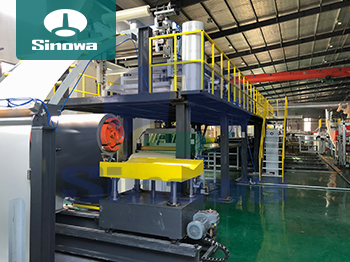


The sandwich panel lines has high adaptability, which may produce various sandwich panel of the PU, PIR and rock wool systems. We may design various products according to the customer’s requirements, including various configurations, so as to meet their demands with flexible price system. Highly integrated and linked control system centralizes all control points at the main central center, achieving parameter linkage, fault self-diagnosis controlled by the whole line and shipping distance control. High-level automatic control system also saves the manpower and reduces the manpower loss for customers.


Concentrated system control is fully realized in the practice of concentrated process control so that the control system of all the movements of the parts in the sandwich panel lines is integrated in one process control console with accessible remote communication to elevate the automation and reduce the allocated number of personnel for the assembly line. The main engine with modularized design achieves the precision operation of the sandwich panel lines, stable and reliable quality, less part and maintenance loss. The whole sandwich panel lines has over 40 innovative inventions, making our products have lots of unique features and the comprehensive performance of our sandwich panel lines leading in the industry.


The precision servo hoisting mechanism employed by the main engine without hydraulic system makes the board thickness control flexible and the customer may conveniently change or adjust the board thickness. There will be not such troubles as hydraulic system adjustment, leakage, maintenance, etc. High-level energy saving and protection design makes the whole sandwich panel lines possible to produce around the clock throughout the year and the customer will save huge budget. In addition, the isolated heat preservation room is constructed for warming the environment. The energy saving and protection design of our sandwich panel lines may guarantee that the customer’s production line may be freely heated and produce in the main time to save more costs for customers.


The high-power low-consumption design quickens the reaction of the sandwich panel lines while energy consumption is kept low. With the brand-new, fully sealed inner insulation design, the energy consumption is controlled at the minimum level to achieve the design objective of less than an hour for the insulation system to be activated from the room temperature above 5℃ to the production process temperature. The energy consumption is only 40% that of those similar products.
In the realm of modern construction and industrial manufacturing, the demand for materials that balance efficiency, durability, and sustainability has driven significant innovations in production technology. Among these innovations, sandwich panel lines stand out as a cornerstone of advanced manufacturing systems, enabling the mass production of composite panels that have revolutionized multiple industries. A sandwich panel line refers to a specialized, automated production system designed to manufacture sandwich panels—three-layer composite structures consisting of a core material sandwiched between two outer facings.
Understanding the Core Components of Sandwich Panel Lines
A standard sandwich panel line is a integrated system composed of multiple interconnected modules, each performing a specific function in the production process. These components work in tandem to ensure a continuous, efficient, and high-quality manufacturing workflow. While configurations may vary based on the type of sandwich panel being produced, the core components typically include the following:
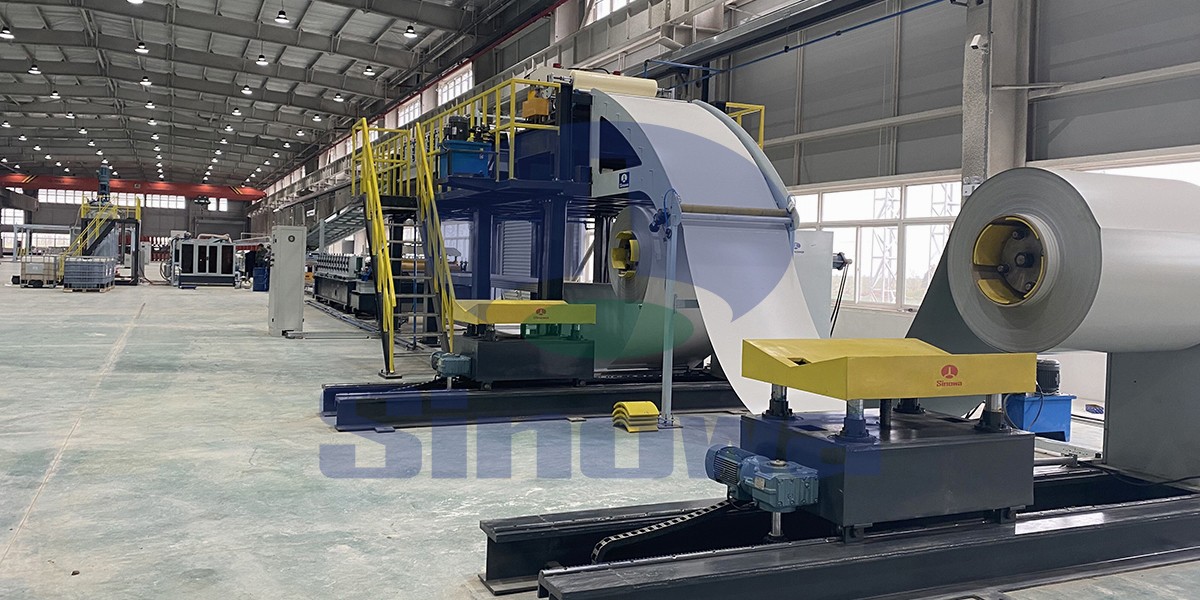
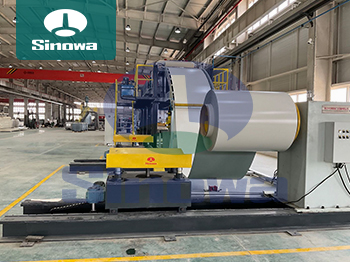
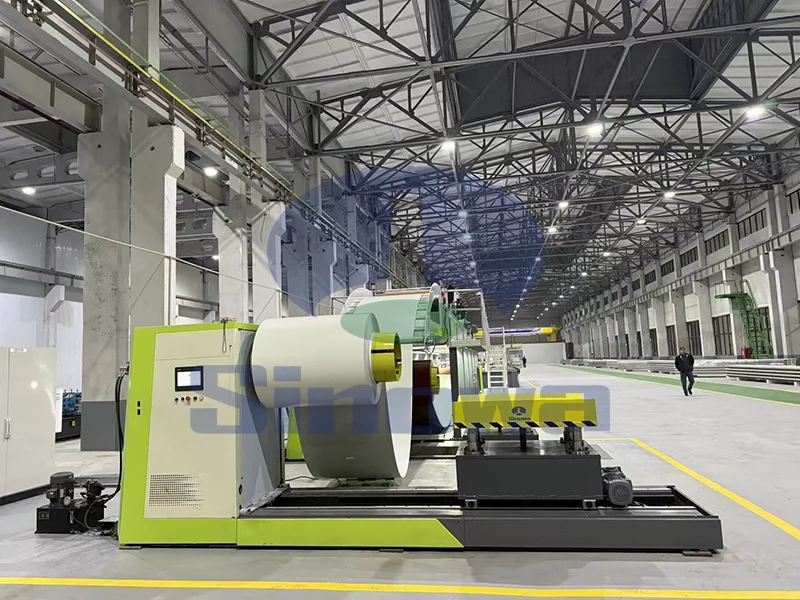
Uncoiling Systems: The production process begins with uncoiling systems, which are responsible for unwinding the coil materials used for the outer facings. These facings are usually made of metal sheets such as steel or aluminum, and the uncoiling system ensures a smooth, consistent feed of these materials into the subsequent processing stages. Equipped with tension control mechanisms, uncoiling systems prevent material deformation and maintain the flatness of the facings, which is critical for the final quality of the sandwich panels.
Roll Forming Machines: After uncoiling, the metal sheets are fed into roll forming machines. These machines use a series of sequentially arranged rollers to gradually bend and shape the flat metal sheets into the desired profile. The roll forming process is a cold-forming technique that avoids the thermal stress associated with hot forming, thereby preserving the mechanical properties of the metal facings. The flexibility of roll forming machines allows for the production of various panel profiles, such as trapezoidal, corrugated, or flat surfaces, to meet different application requirements.
Core Material Processing Modules: Depending on the type of core material, this module processes and positions the core between the two outer facings. For foam cores (such as polyurethane or expanded polystyrene), the module includes a high-pressure mixing and injection system that precisely mixes the foam components and injects the liquid mixture between the facings. For mineral wool or rock wool cores, the module consists of cutting and positioning systems that cut the core material into the required dimensions and place it accurately between the facings. This module also includes sealing systems to prevent core material leakage and ensure proper bonding with the facings.
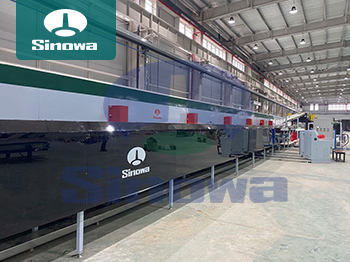
Laminating and Curing Systems: Once the core material is placed between the facings, the composite structure enters the laminating and curing systems. These systems typically use double-belt presses that apply uniform pressure and controlled temperature to the panel. The pressure ensures intimate contact between the core and the facings, promoting strong bonding, while the temperature accelerates the curing process of the adhesive or foam core. The double-belt design guarantees the flatness and planarity of the final panel, as the belts move synchronously to avoid warping.
Cutting Systems: After curing, the continuous panel is cut into the desired lengths by automated cutting systems. These systems are equipped with flying saws or disk blades that can cut the panel while it is still moving, ensuring high precision and minimizing production downtime. The cutting parameters, such as length and angle, can be adjusted through the control system to accommodate different customer requirements.
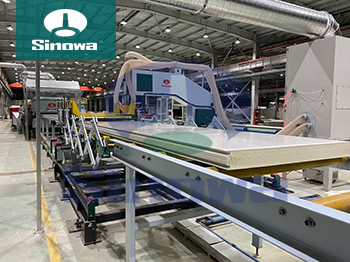
Handling and Stacking Systems: The final stage of the production line involves handling and stacking the finished panels. These systems include conveyors, cooling stations, turning mechanisms, and stacking machines that transport the cut panels, cool them to room temperature, and stack them neatly for storage or transportation. Some advanced lines also include wrapping systems to protect the panels from damage during handling.
Control Systems: The entire production line is managed by a central control system, typically based on programmable logic controllers (PLC) and human-machine interfaces (HMI). The control system monitors and adjusts all production parameters, such as material feed rate, roll forming pressure, foam injection volume, curing temperature, and cutting length. This automation ensures consistent product quality, reduces human error, and allows for real-time process optimization.
Working Principles of Sandwich Panel Lines
The operation of a sandwich panel line follows a continuous, sequential workflow that integrates mechanical, chemical, and electrical processes. While the specific steps may vary slightly depending on the type of core material, the general working principle can be summarized as follows:
Material Preparation: The coil materials for the outer facings are loaded onto the uncoiling systems, and the core material components (such as foam precursors or mineral wool boards) are prepared and fed into the respective processing modules. The control system is programmed with the desired production parameters, including panel thickness, length, profile, and core density.
Facing Forming: The uncoiled metal sheets are fed into the roll forming machines, where they are gradually shaped into the required profile. The roll forming process is precise and continuous, ensuring that the facings have consistent dimensions and surface quality.
Core Application: For foam core panels, the high-pressure mixing system combines the foam components (such as isocyanate and polyol for polyurethane) in the correct ratio and injects the mixture between the two formed facings. The foam expands rapidly to fill the gap between the facings, adhering to the inner surfaces. For mineral wool core panels, the pre-cut core material is placed between the facings, and adhesive is applied to ensure bonding.
Laminating and Curing: The composite structure (two facings with core material in between) enters the double-belt press. The press applies uniform pressure to ensure that the core is fully bonded to the facings, and the controlled temperature accelerates the curing of the foam or adhesive. The curing time varies depending on the core material, ranging from a few minutes for foam cores to longer periods for some adhesive-bonded cores.
Cutting and Finishing: Once the panel is fully cured, it is fed into the cutting system, which cuts it into the desired lengths while the panel is in motion. The cut panels are then transported to the cooling station to reach room temperature, after which they are turned, stacked, and packaged as needed.
The continuous nature of this workflow allows for high production efficiency, with modern lines capable of producing up to 1,500 meters of panel per hour. The automation of the process ensures that each panel meets the same quality standards, reducing variability and waste.
Types of Sandwich Panel Lines
Sandwich panel lines are classified based on the type of core material they process, as different core materials require specialized processing modules. The most common types include:
Polyurethane (PU) Sandwich Panel Lines
PU sandwich panel lines are designed to produce panels with a polyurethane foam core. Polyurethane foam is known for its excellent thermal insulation, lightweight properties, and strong bonding ability. These lines are equipped with high-pressure foaming machines that precisely meter and mix the foam components, ensuring consistent foam density and quality. The foaming process is environmentally friendly when using pentane as a blowing agent instead of chlorofluorocarbons. PU sandwich panel lines are widely used in the production of panels for cold storage facilities, warehouses, and building envelopes due to their superior insulation performance.Expanded Polystyrene (EPS) Sandwich Panel Lines
EPS sandwich panel lines manufacture panels with an expanded polystyrene foam core. EPS foam is lightweight, cost-effective, and has good thermal insulation properties. These lines typically use pre-expanded EPS boards, which are cut to size and placed between the metal facings. The bonding between the EPS core and the facings is achieved through adhesive application. EPS sandwich panel lines are popular in the construction of residential buildings, industrial workshops, and temporary structures due to their low cost and ease of production. Recent innovations in these lines have focused on improving the fire resistance of EPS panels by incorporating fire-retardant additives.Rock Wool (Mineral Wool) Sandwich Panel Lines
Rock wool sandwich panel lines produce panels with a rock wool core, which is known for its excellent fire resistance, sound insulation, and thermal stability. These lines include specialized modules for cutting rock wool boards into lamellae or trapezoidal shapes, as well as dust collection systems to minimize dust pollution during processing. The rock wool core is placed between the metal facings and bonded with adhesive. Rock wool sandwich panel lines are commonly used in the production of panels for high-rise buildings, industrial facilities, and areas with strict fire safety requirements.
Continuous vs. Batch Production Lines
In addition to classification by core material, sandwich panel lines can also be divided into continuous and batch production lines. Continuous lines are designed for high-volume, uninterrupted production, offering high efficiency and consistent quality. They are ideal for large-scale manufacturers producing standardized panels. Batch lines, on the other hand, produce panels in discrete batches, allowing for greater flexibility in panel dimensions and core materials. They are suitable for medium-volume production and manufacturers serving diverse customer requirements.
Advantages of Sandwich Panel Lines in Manufacturing
Sandwich panel lines offer numerous advantages over traditional manufacturing methods, making them a preferred choice for composite panel production. These advantages include:
High Efficiency and Productivity: The continuous, automated workflow of sandwich panel lines enables high production rates, significantly increasing output compared to manual or semi-automated processes. Modern lines can produce hundreds of meters of panel per hour, meeting the large-scale demand of the construction and industrial sectors.
Consistent Product Quality: Automation ensures that all production parameters are tightly controlled, resulting in panels with consistent dimensions, core density, and bonding strength. This consistency reduces product variability and waste, improving the overall quality and reliability of the panels.
Versatility and Customization: Sandwich panel lines can be easily adjusted to produce panels of different sizes, thicknesses, profiles, and core materials. This versatility allows manufacturers to cater to a wide range of applications and customer requirements, from standard wall panels to specialized cold storage panels.
Cost-Effectiveness: While the initial investment in a sandwich panel line may be high, the long-term cost savings are significant. Automation reduces labor costs, and the high efficiency and low waste minimize material and energy costs. Additionally, the lightweight nature of sandwich panels reduces transportation and installation costs for end-users.
Environmental Sustainability: Modern sandwich panel lines incorporate eco-friendly technologies, such as the use of pentane as a blowing agent for foam cores (replacing ozone-depleting substances) and dust collection systems for rock wool processing. The panels themselves are energy-efficient, reducing the carbon footprint of buildings by minimizing heating and cooling requirements. Many sandwich panels are also recyclable, further enhancing their sustainability.
Improved Safety: Automation reduces the need for manual intervention in potentially hazardous processes, such as foam mixing and cutting. Additionally, the panels produced by these lines often have superior fire resistance and structural integrity, improving the safety of the buildings in which they are used.
Applications of Sandwich Panels Produced by Sandwich Panel Lines
The panels manufactured by sandwich panel lines are versatile and find applications in a wide range of industries. The key applications include:
Building and Construction
In the construction industry, sandwich panels are widely used for wall cladding, roofing, partitions, and ceilings. Their excellent thermal insulation properties help reduce energy consumption in buildings, making them compliant with modern green building standards. The lightweight nature of the panels also speeds up construction, reducing project timelines and labor costs. PU and EPS sandwich panels are commonly used in residential and commercial buildings, while rock wool panels are preferred for high-rise buildings and public facilities due to their fire resistance.Cold Storage and Logistics
Cold storage facilities, such as refrigerated warehouses, food processing plants, and pharmaceutical storage centers, require materials with superior thermal insulation to maintain stable temperatures. PU and EPS sandwich panels are ideal for these applications, as their foam cores have low thermal conductivity. Sandwich panel lines produce specialized cold storage panels with enhanced vapor barriers and antimicrobial properties to prevent moisture buildup and contamination. The rapid construction enabled by these panels is also beneficial for the expansion of the cold chain logistics sector.Industrial Facilities
Industrial workshops, factories, and warehouses often use sandwich panels for wall and roof construction. The panels' durability, sound insulation, and fire resistance make them suitable for harsh industrial environments. They can withstand extreme temperatures, humidity, and chemical exposure, ensuring long-term performance. Additionally, the quick installation of sandwich panels minimizes downtime during facility construction or expansion.Modular and Prefabricated Construction
The growing trend of modular and prefabricated construction has increased the demand for sandwich panels. These panels are used to manufacture prefabricated modules, such as portable cabins, modular homes, and office units. The lightweight and durable nature of the panels makes them easy to transport and assemble, reducing construction time and costs. Sandwich panel lines can produce standardized panels that fit seamlessly into modular construction systems, ensuring consistency and quality.Other Applications
Sandwich panels are also used in the automotive industry for the production of truck bodies and refrigerated vehicles. In the aerospace industry, lightweight sandwich panels are used in aircraft interiors. Additionally, they find applications in sound barriers along highways and railways, thanks to their excellent acoustic insulation properties.
Future Trends in Sandwich Panel Line Technology
The sandwich panel line industry is continuously evolving, driven by technological advancements, environmental concerns, and changing market demands. The key future trends include:
Digitalization and Smart Manufacturing: The integration of digital technologies, such as the Internet of Things (IoT), artificial intelligence (AI), and building information modeling (BIM), is transforming sandwich panel lines into smart manufacturing systems. IoT sensors monitor production parameters in real-time, allowing for predictive maintenance and process optimization. AI algorithms can analyze production data to improve efficiency and quality, while BIM integration enables the seamless integration of sandwich panels into building design processes.
Enhanced Sustainability: The focus on environmental sustainability will drive further innovations in sandwich panel line technology. Manufacturers will continue to develop eco-friendly core materials, such as bio-based polyurethane foams and recycled EPS. Production lines will also become more energy-efficient, with the adoption of renewable energy sources and energy recovery systems. Additionally, the recyclability of sandwich panels will be improved, reducing waste in the construction industry.
Advanced Material Innovations: Research and development will focus on improving the performance of sandwich panels, such as increasing their fire resistance, thermal insulation, and structural strength. New core materials, such as aerogel-enhanced foams and high-performance mineral wool, will be integrated into production lines. These materials will offer superior properties, expanding the applications of sandwich panels to more demanding environments.
Increased Customization Capabilities: As market demands become more diverse, sandwich panel lines will be designed to offer greater customization. Advanced roll forming machines and cutting systems will allow for complex panel profiles and shapes. The control systems will be more user-friendly, enabling operators to quickly switch between different production parameters and panel types.
Global Expansion in Emerging Markets: The growth of the construction and industrial sectors in emerging economies will drive the demand for sandwich panel lines. Manufacturers will expand their presence in these markets, offering cost-effective and adaptable production solutions. This expansion will also lead to the transfer of technology and the adoption of global best practices in manufacturing.
Conclusion
Sandwich panel lines have emerged as a critical technology in modern manufacturing, enabling the efficient production of high-quality composite panels that meet the diverse needs of the construction, logistics, and industrial sectors. Their integrated, automated design ensures high efficiency, consistent quality, and cost-effectiveness, while their versatility allows for the production of panels with different core materials and profiles. As the industry continues to evolve, driven by digitalization, sustainability, and material innovations, sandwich panel lines will play an even more important role in shaping the future of construction and manufacturing. By embracing these advancements, manufacturers can meet the growing demand for energy-efficient, durable, and sustainable building materials, contributing to a more sustainable and resilient built environment.
《Sandwich Panel Lines》Update Date: 2026/1/8
URL: https://www.sinowamachine.cn/en/tag/sandwich-panel-lines.html
- PU Sandwich Panel Making Machine
- Rockwool Sandwich Panel Production Line
- PU Sandwich Panel Machine
- PU Sandwich Panel Production Line
- Mineral Wool Sandwich Panel Machine
- PUF Panel Machine
- Rock Wool Sandwich Panel Line
- Sandwich Panel Machines
- Sandwich Panel Lines
- Rockwool Sandwich Panel Machine
- Rockwool Sandwich Panel Line
- PU Sandwich Panel Line
- PU Panel Machine
- Foam Forming Machine
- Continuous Sandwich Panel Line
- Continuous PU Sandwich Panel Line
- PIR Sandwich Panel Line
- Polyurethane Sandwich Panel Line
- Automatic PU Sandwich Panel Production Line
- PU Foam Sandwich Panel Production Line