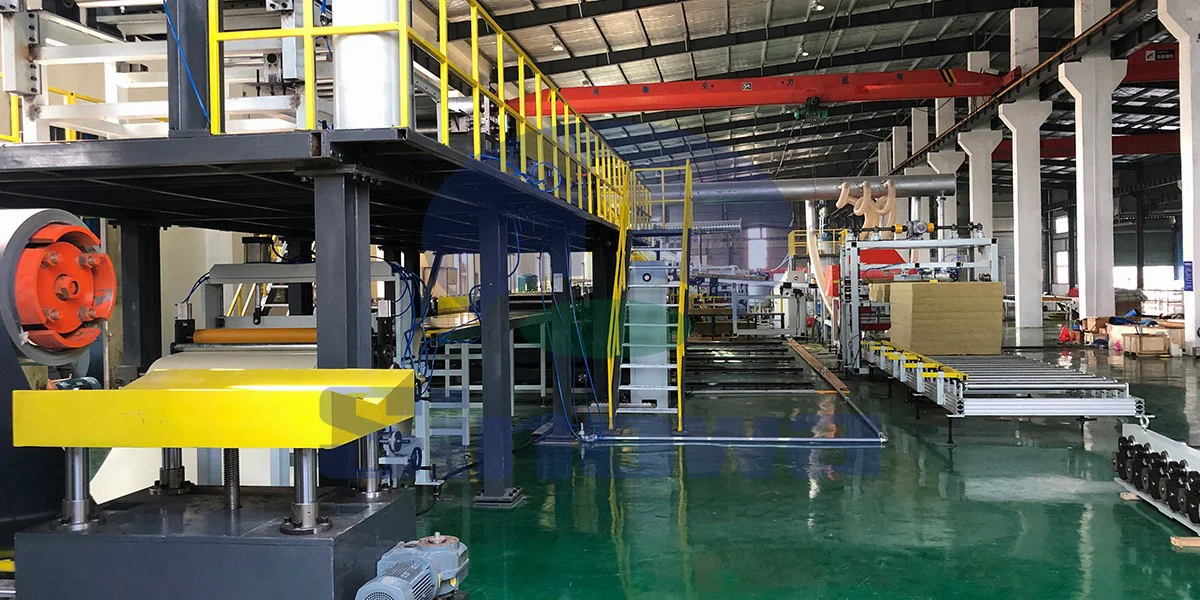
Rockwool Sandwich Panel Production Line
Rockwool Sandwich Panel Production Line. Modular automated rock wool sandwich panel making machine. Custom continuous rock wool panel machinery with precise cutting & laminating. High efficiency, low labor. Reliable supplier, fast technical support.
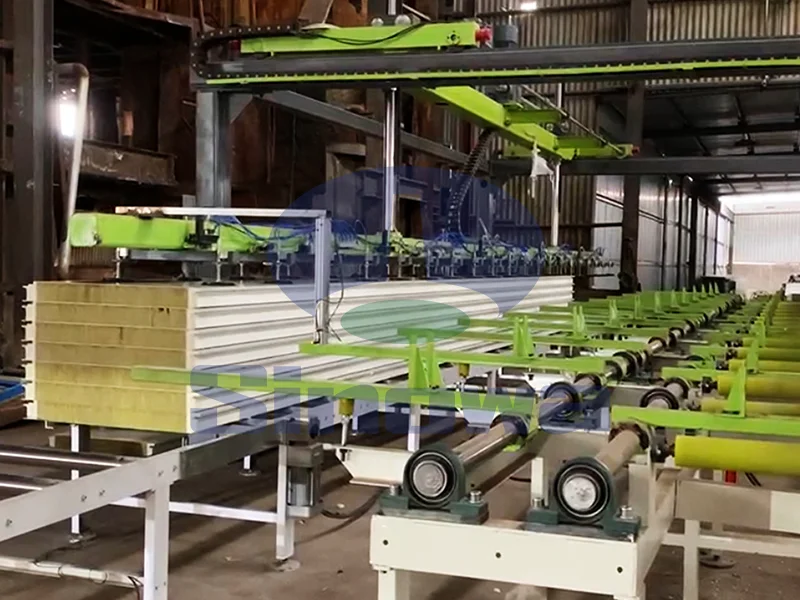
Overview of Sandwich Panel Plants
This rockwool sandwich panel production line is an automated continuous system that bonds rockwool cores and metal facings via gluing, pressing and curing. It consists of unwinding, forming, gluing, pressing, cutting and stacking units. It makes wall, roof and partition panels widely used in factories, cleanrooms and modular buildings. Featuring stable pressure control and flexible parameter adjustment, it uses a central control system with real-time monitoring. Complete installation guidance, operator training and remote after-sales support guarantee steady operation.
Sinowa rockwool sandwich panel production line reaches world-class standards in equipment efficiency, automatic control, HMI, environmental protection and energy-saving performance. It adopts disruptive key technologies and delivers excellent cost-performance, supporting remote interactive communication.
-
![Rockwool Sandwich Panel Production Line]() Modular Design: The rockwool sandwich panel production line features modular design with freely combinable and interchangeable components. Core parts are machined by machining centers to minimize human-factor interference. It achieves high production efficiency and fast delivery with low maintenance loss. The sandwich panel equipment owns more than 40 innovative patented technologies.
-
![Rockwool Sandwich Panel Production Line]() Multi-product Manufacturing Capacity: It can automatically produce roof, wall and cold-storage sandwich panels via configuration switching. It supports sandwich panels with core materials including PU, PIR, rock wool and glass wool. Custom configurations and flexible pricing packages are available upon customer requirements.
-
![Rockwool Sandwich Panel Production Line]() Control System Advantages: Highly integrated and linked control system centralizes all control points on the main console. Functions including parameter linkage, full-line fault self-diagnosis, conveying distance control and remote communication are available to greatly cut manpower input.
-
![Rockwool Sandwich Panel Production Line]() Main Machine Features: The main engine adopts a precision servo hoisting mechanism without hydraulic system. Board thickness can be adjusted flexibly and conveniently, avoiding common troubles of hydraulic systems such as leakage, commissioning and maintenance, ensuring precise operation and stable product quality.
-
![Rockwool Sandwich Panel Production Line]() Energy-saving & Environmental-friendly Performance: Equipped with an independent heating-insulation room and brand-new fully-sealed inner insulation structure. It supports round-the-clock production all year round. The insulation system can heat up from ambient temperature above 5℃ to process temperature within less than one hour. Its energy consumption is only 40% of similar products, which greatly reduces production costs.
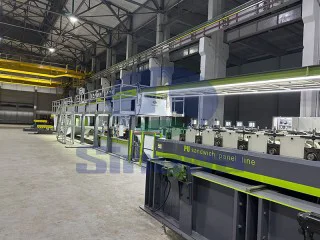
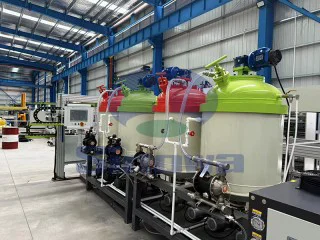
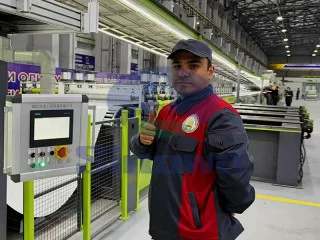

Main Technical Parameters of Sandwich Panel Machinery
- Production types: PU, PIR, phenolic, rockwool panels
- Production usage: insulation panels, decorative panels
- Sheet surface options: aluminum foil, non-woven fabric, paper, naked surface
- Product thickness: 10m -200 mm
- Production speed: 3.0m - 25m
- Foaming method: two or multi-component foaming
- Foaming agent: pentane or 141B
- Line length: 45m -100m, Customer Optional
A rockwool sandwich panel production line is a continuous automated manufacturing system designed for composite panel fabrication, which bonds rockwool core material with metal facings under controlled pressure and temperature. This integrated production system turns raw rockwool strips and metal coils into finished structural panels in a streamlined sequence. It is widely adopted to deliver consistent composite panels with thermal insulation, fire resistance and structural rigidity for construction and industrial enclosure projects.

Working Principle
The core working logic of this production line relies on continuous lamination and curing. Metal sheets from unwinding stations are pre-formed and surface-treated first, while rockwool core materials are arranged and aligned between the upper and lower metal facings. As the assembly passes through the glue spreading unit, adhesive is evenly applied to the contact surfaces between rockwool and metal. The stacked structure then enters the double-belt pressing zone, where steady pressure and moderate heating activate the adhesive. Under stable clamping force, the adhesive fully wets both the fibrous rockwool surface and metal substrate to form a solid bonded composite. After curing, the continuous panel strip is cut into preset lengths, followed by edge trimming and stacking. The whole process maintains continuous movement to avoid intermittent bonding defects and ensure uniform adhesion across the full panel surface.
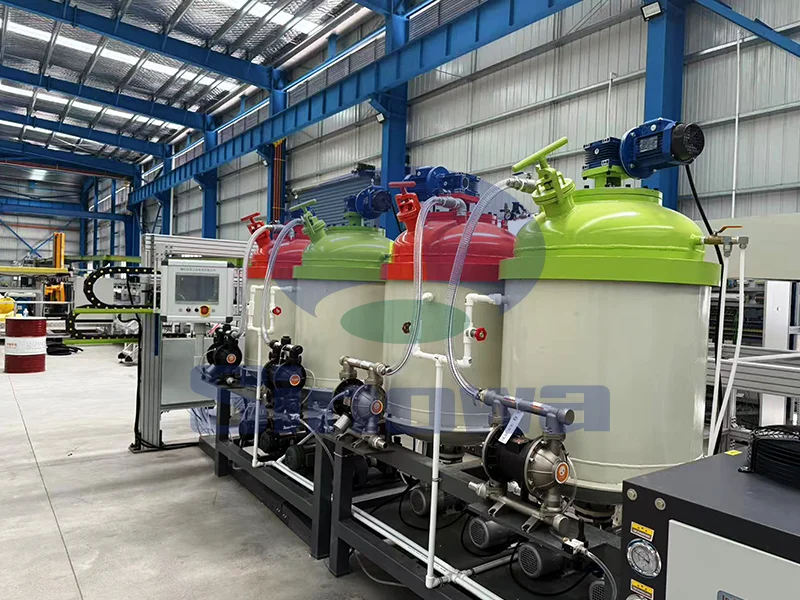
Main Components of the Whole Machine
The complete line consists of multiple functional units connected in sequence. Unwinding units hold and feed upper and lower metal coils, equipped with tension control to prevent sheet wrinkling. A forming section shapes flat metal sheets into designed profiles, including tongue-and-groove edges for easy panel interconnection. The rockwool feeding and arranging station automatically conveys, separates and aligns rockwool blocks or strips, adjusting core density and layout as required. Glue dispensing systems meter and spread adhesive uniformly on bonding surfaces. The continuous double-belt press is the key unit, providing constant pressure and heating environment for curing. A post-curing channel keeps panels in a stable environment to complete adhesive crosslinking before cutting. Flying saw cutting equipment cuts continuous panels to target lengths without stopping line operation. Auxiliary units include edge trimming devices, panel conveying rollers, automatic stacking frames and waste collection mechanisms.
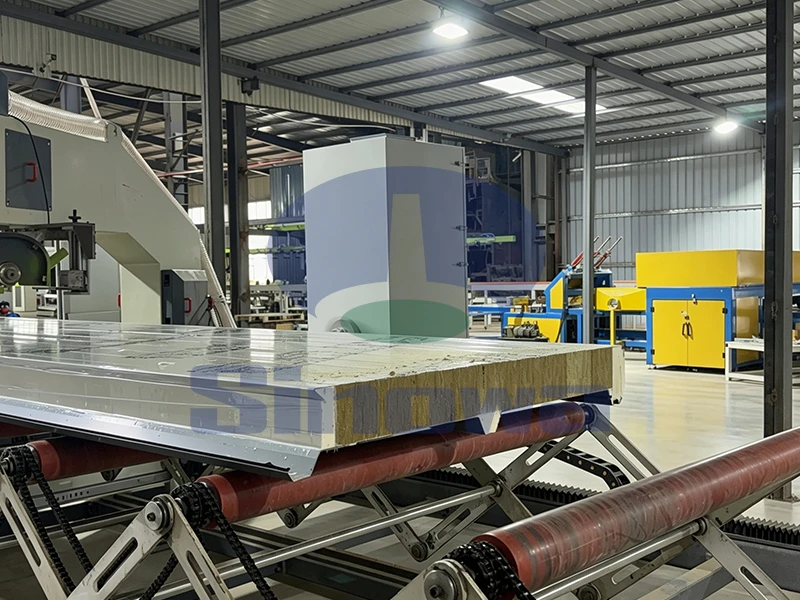
Production Process Flow
The production starts with loading metal coils onto unwinders, where metal sheets are pulled out and sent to the roll forming section for profiling. Meanwhile, rockwool raw materials are transported to the feeding station and arranged into continuous core layers. Adhesive is coated on the inner sides of both upper and lower metal facings. The rockwool core is sandwiched between the two metal sheets, and the composite assembly moves into the pressing and curing section. After sufficient bonding and curing inside the press, the continuous composite strip travels forward to the cutting station. The flying saw cuts panels to the required dimensions. Subsequent processes include edge trimming, surface inspection, conveying and automatic stacking. Finished panels are bundled for transfer to storage areas. All steps run in coordination to realize non-stop continuous production.
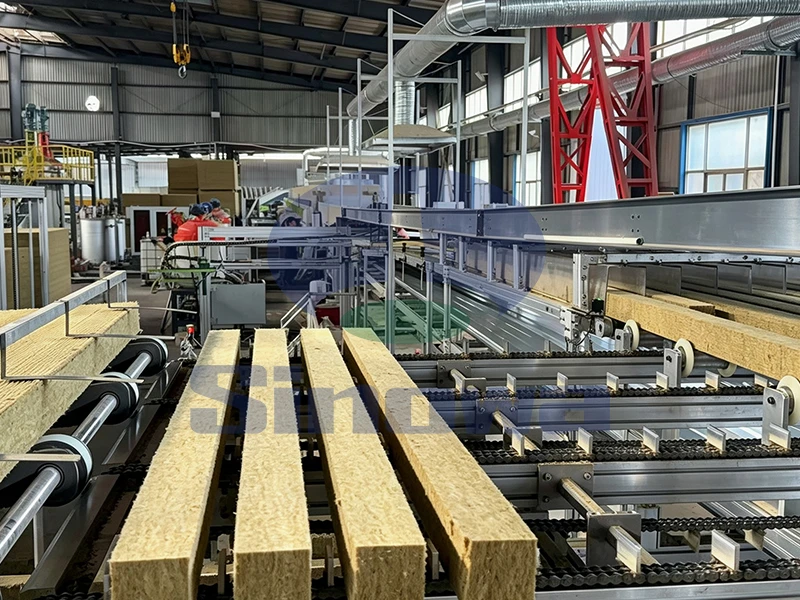
Available Panel Types and Application Scenarios
This production line can manufacture various rockwool sandwich panels according to profile designs. Common types include wall panels with interlocking joints, roof panels with anti-leakage structural edges, partition panels for internal separation, and special panels with customized surface shapes. Different panel variants can be produced by switching forming rollers and adjusting rockwool layout methods.
These panels serve a broad range of application scenarios. They are used for exterior wall envelopes and roof systems of industrial workshops and warehouses. Cleanroom enclosures for pharmaceutical and electronic manufacturing also adopt such panels for stable insulation and easy cleaning. Temporary and permanent modular buildings, cold storage auxiliary partitions, equipment sound insulation covers and fire-separating enclosure structures are typical application fields. The panels are also suitable for agricultural planting houses and livestock breeding sheds that need stable thermal management.
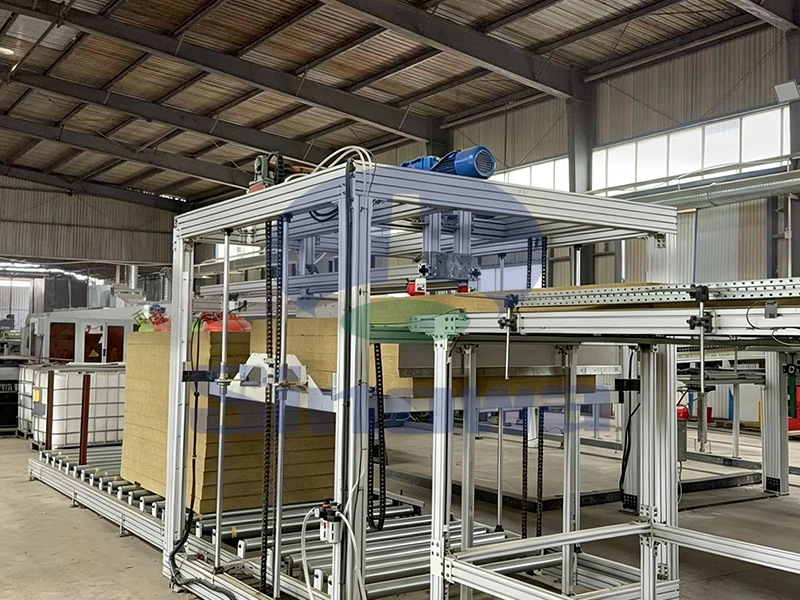
Equipment Advantages and Features
This production line delivers outstanding operational and product performance. Continuous operation greatly improves production efficiency compared with batch-type panel making equipment, supporting stable long-hour running. The double-belt pressing structure ensures even pressure distribution, so bonding strength stays consistent over the entire panel length. The line supports flexible adjustment of panel thickness, width and length by modifying parameter settings and replacing forming rollers. It has good compatibility with different rockwool core forms and multiple metal facing materials. Mechanical alignment devices reduce core offset during lamination, lowering the rate of defective products. Modular unit layout makes on-site layout flexible and reserves space for future function expansion. Low vibration design reduces noise during operation and extends the service life of transmission parts.
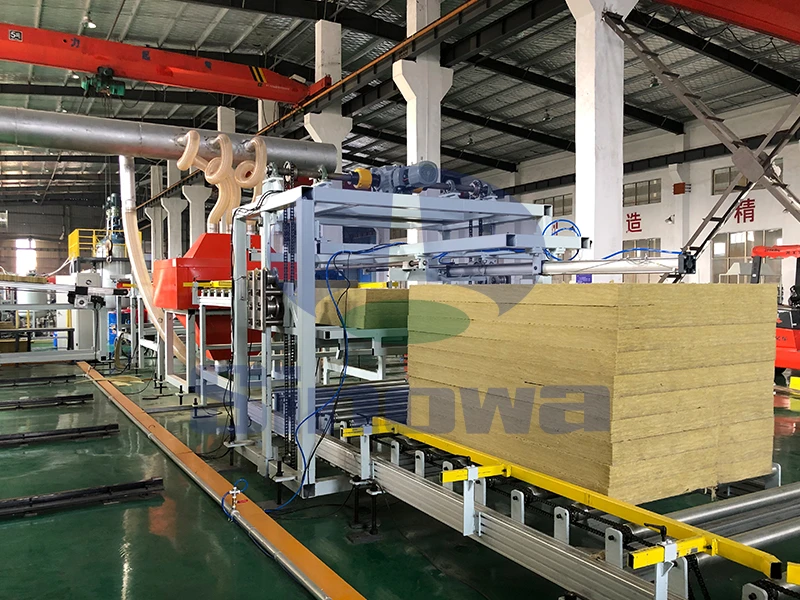
Control System and Quality Control
The production line adopts an integrated central control system. Operators set production parameters on the human-machine interface, including line speed, glue dosage, pressing pressure, heating temperature and cutting length. The system synchronizes the speed of each unit automatically to prevent mismatched feeding. Real-time sensors monitor tension of metal sheets, rockwool feeding status, pressure inside the press and temperature of the curing zone. Abnormal parameters will trigger prompt alarms for operators to make timely adjustments.
For quality control, key inspection points are set along the flow. Surface condition of metal facings and rockwool core is checked before lamination. Adhesive coating thickness is monitored to avoid insufficient or excessive glue. After cutting, finished panels are sampled to check dimension accuracy, flatness and bonding integrity. Surface appearance is inspected to remove panels with scratches, gaps or core misalignment. Production data can be recorded for traceability of each production batch.

Installation, Matching and After-sales Service
Before installation, the foundation layout is planned according to site space, with reserved space for raw material feeding and finished product output. All units are positioned and leveled, then transmission connections, pipelines and control circuits are assembled and tested step by step. After mechanical assembly, joint debugging is carried out to synchronize all stations and run trial production. Supporting auxiliary facilities include air supply systems for glue units, power distribution cabinets and dust collection devices for rockwool scraps.
The after-sales service covers multiple links. Technical guidance is provided during equipment installation and commissioning. Professional training is offered for on-site operators, covering normal operation, parameter adjustment, daily maintenance and common fault judgment. Remote technical support is available to assist with troubleshooting. Spare parts supply channel is accessible for wearing components. Periodic follow-up service is arranged to check equipment running status and give maintenance suggestions, helping maintain stable long-term operation of the whole production line.

Conclusion
As a comprehensive automated manufacturing solution, the rockwool sandwich panel production line integrates material feeding, forming, gluing, continuous pressing, curing and cutting. It can produce diversified rockwool composite panels for construction and industrial enclosure uses. With reliable control systems and complete supporting services, the equipment balances production capacity, product consistency and operational flexibility, remaining a preferred solution for sandwich panel manufacturing.
- Continuous PU Sandwich Panel Line
- Glass Wool Sandwich Panel Production Line
- Insulation Board Production Line
- Mineral Wool Sandwich Panel Production Line
- PIR Sandwich Panel Production Line
- Polyurethane Sandwich Panel Line
- Polyurethane Sandwich Panel Machine
- Polyurethane Sandwich Panel Manufacturing Line
- Polyurethane Sandwich Panel Production Line
- PU Sandwich Panel Line
- PU Sandwich Panel Machine
- PU Sandwich Panel Production Line
- PUR Sandwich Panel Production Line
- Rock Wool Sandwich Panel Production Line
- Sandwich Panel Lines
- Sandwich Panel Machines
- Sandwich Panel Manufacturing Line
- Sandwich Panel Production Line
- Sandwich Panel Production Machinery
- Sandwich Panel Production Machines