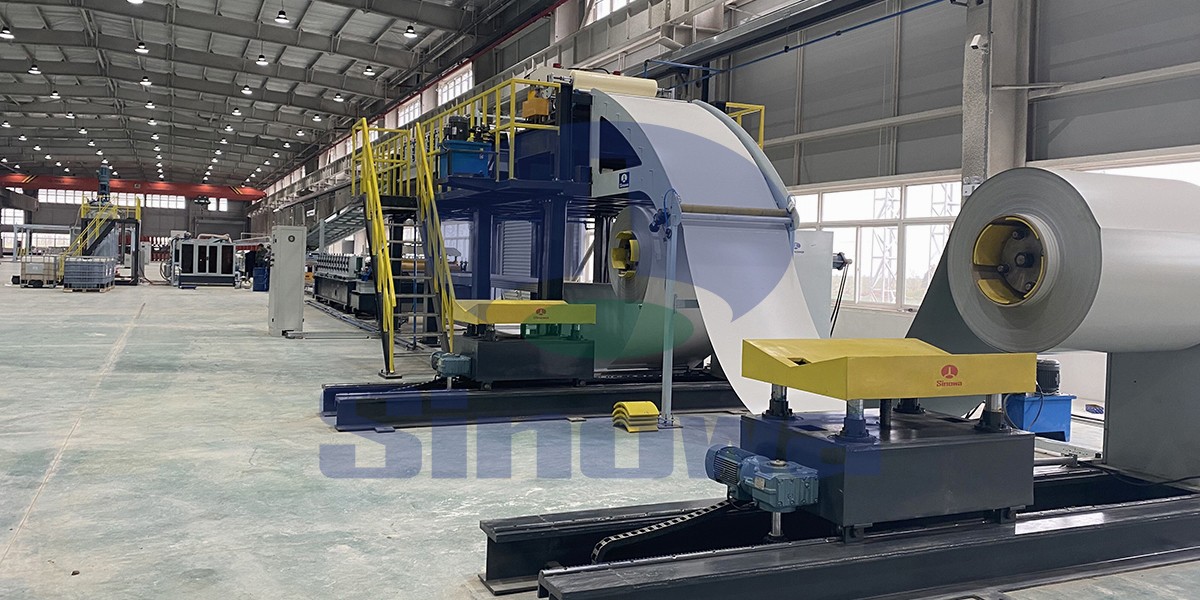
PU Sandwich Panel Production Line
Sinowa is pu sandwich panel production line manufacturer from china, dedicated to the research and development of high-end and high-efficiency, Sinowa is comprehensively taking the leading position in terms of efficiency, automation control level, HMI, environment protection and energy consumption, with subversive designs made in some critical technological fields to procure exceptional cost performance and customer-friendly experience for the entire pu sandwich panel production line. The adoption of system integration technology and bus control technology accomplishes the full automatization of integrated and coordinated control of the entire pu sandwich panel production line with accessible remote interactive communication. Ranking the first-class level in the world, it is currently the pu sandwich panel production line in the market taking a comprehensive lead in high performance.
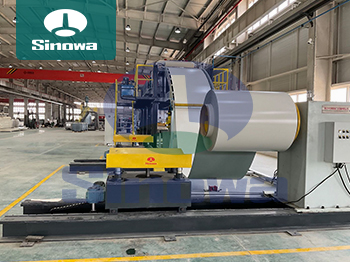
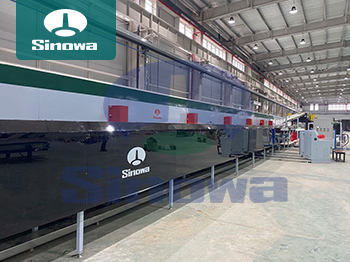
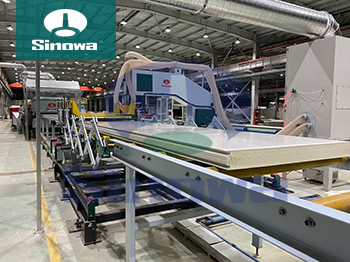
Based on the continuous technological pursuit, the pu sandwich panel production line developed by Sinowa provides you with high-efficiency industrial value. Based on China's cost advantage and our hard-working technology concept, our pu sandwich panel production line has a world-leading price-performance advantage. pu sandwich panel production line can meet a variety of production needs of customers.The whole pu sandwich panel production line design concept of modularization enables all our components to be integrated and combined at will. Our pu sandwich panel production line can easily automate the production of roof sandwich panel, wall sandwich panel, cold storage sandwich panel and other products by different combination and configuration selection and siple switching. The inner core layer can be polyrethane or rock wool, glass wool, an so on.
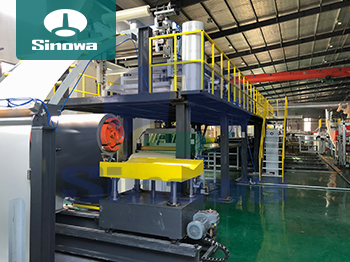


The pu sandwich panel production line has high adaptability, which may produce various sandwich panel of the PU, PIR and rock wool systems. We may design various products according to the customer’s requirements, including various configurations, so as to meet their demands with flexible price system. Highly integrated and linked control system centralizes all control points at the main central center, achieving parameter linkage, fault self-diagnosis controlled by the whole line and shipping distance control. High-level automatic control system also saves the manpower and reduces the manpower loss for customers.


Concentrated system control is fully realized in the practice of concentrated process control so that the control system of all the movements of the parts in the pu sandwich panel production line is integrated in one process control console with accessible remote communication to elevate the automation and reduce the allocated number of personnel for the assembly line. The main engine with modularized design achieves the precision operation of the pu sandwich panel production line, stable and reliable quality, less part and maintenance loss. The whole pu sandwich panel production line has over 40 innovative inventions, making our products have lots of unique features and the comprehensive performance of our pu sandwich panel production line leading in the industry.


The precision servo hoisting mechanism employed by the main engine without hydraulic system makes the board thickness control flexible and the customer may conveniently change or adjust the board thickness. There will be not such troubles as hydraulic system adjustment, leakage, maintenance, etc. High-level energy saving and protection design makes the whole pu sandwich panel production line possible to produce around the clock throughout the year and the customer will save huge budget. In addition, the isolated heat preservation room is constructed for warming the environment. The energy saving and protection design of our pu sandwich panel production line may guarantee that the customer’s production line may be freely heated and produce in the main time to save more costs for customers.


The high-power low-consumption design quickens the reaction of the pu sandwich panel production line while energy consumption is kept low. With the brand-new, fully sealed inner insulation design, the energy consumption is controlled at the minimum level to achieve the design objective of less than an hour for the insulation system to be activated from the room temperature above 5℃ to the production process temperature. The energy consumption is only 40% that of those similar products.
In the modern construction and manufacturing industries, polyurethane (PU) sandwich panels have emerged as a pivotal composite material, celebrated for their exceptional thermal insulation, structural rigidity, lightweight properties, and durability. Behind the mass production of these high-performance panels lies the PU sandwich panel production line—a sophisticated, automated system that integrates mechanical engineering, chemical processing, and precision control technologies.
The PU sandwich panel production line is a continuous manufacturing system designed to produce composite panels consisting of two outer facing materials (typically steel, aluminum, or fiber-reinforced sheets) and a core of rigid polyurethane foam. Unlike traditional manual or semi-automatic production methods, modern lines leverage full-process automation to ensure consistent product quality, high production efficiency, and minimal material waste. The seamless coordination of various subsystems—from raw material feeding to finished product stacking—enables the mass production of panels with customizable dimensions, thicknesses, and performance characteristics, catering to the diverse needs of different industries.
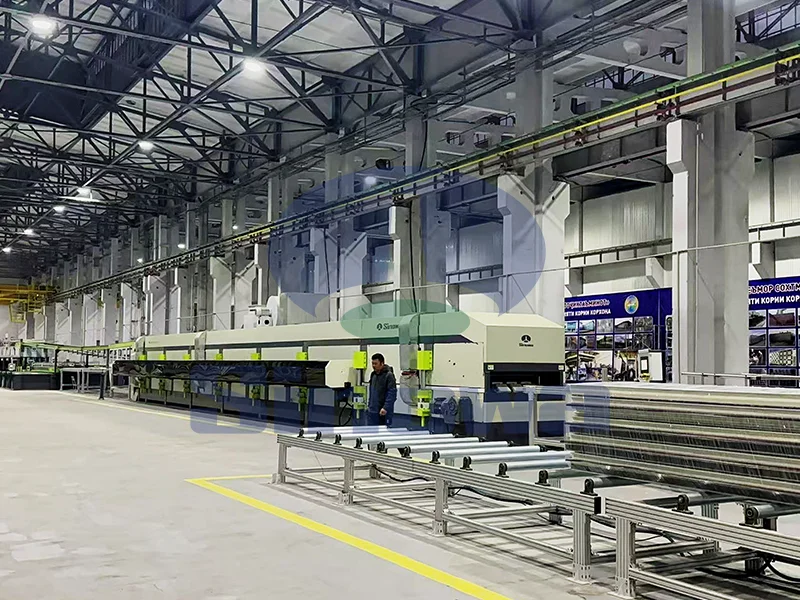
Core Components of the PU Sandwich Panel Production Line
A standard PU sandwich panel production line comprises several interconnected subsystems, each playing a critical role in the manufacturing process. These components work in tandem to transform raw materials into finished panels, with each stage carefully controlled to maintain product integrity and performance.
1. Decoiling and Feeding System
The decoiling and feeding system is the starting point of the production line, responsible for unrolling and transporting the facing material coils (such as pre-painted steel coils or aluminum coils) into the subsequent processing stages. This system typically includes decoilers, levelers, and feeding rollers. Decoilers are equipped with tension control mechanisms to ensure smooth unrolling of the coils, preventing material deformation or wrinkling. Levelers are used to flatten the uncoiled sheets, eliminating any residual stresses from the coiling process and ensuring the flatness of the final panel surfaces. Feeding rollers, driven by variable-frequency motors, transport the facing materials at a consistent speed, synchronizing with the rest of the production line to maintain process continuity.
For production lines that require double-sided facing materials (the most common configuration for PU sandwich panels), two sets of decoiling and feeding systems are employed—one for the upper facing sheet and one for the lower facing sheet. This dual-system design ensures that both facing materials are fed into the roll forming stage simultaneously and at the same speed, laying the foundation for precise panel formation.
2. Roll Forming System
The roll forming system is responsible for shaping the flat facing sheets into the desired cross-sectional profiles. This system consists of a series of tandem rolling stands, each equipped with precision-engineered rollers that gradually bend the sheet metal into the target shape (e.g., trapezoidal, corrugated, or flat profiles). The rolling process is progressive—each stand imparts a small amount of deformation to the sheet, ensuring that the material does not undergo excessive stress that could lead to cracking or weakening.
The roll forming system is highly customizable, allowing for the production of panels with different profile designs to meet specific structural or aesthetic requirements. For example, trapezoidal profiles are commonly used for roof panels due to their excellent water drainage and wind resistance, while flat profiles are preferred for interior wall panels. Advanced roll forming systems are equipped with quick-change roller sets, enabling manufacturers to switch between different profile designs efficiently, reducing downtime and improving production flexibility.
3. PU Foam Injection and Mixing System
The PU foam injection and mixing system is the core of the production line, as it determines the quality of the insulating core—the key component that gives PU sandwich panels their exceptional thermal and acoustic properties. This system consists of material storage tanks, metering pumps, a high-pressure mixing head, and an injection nozzle.
The PU foam is formed by the chemical reaction of two main components: polyol and isocyanate. These components are stored in separate tanks and transported to the mixing head via metering pumps. The metering pumps are controlled by precision sensors to ensure the correct ratio of polyol to isocyanate, as any deviation from the optimal ratio can affect the foam's density, thermal conductivity, and mechanical strength. Once in the mixing head, the two components are mixed at high pressure, creating a homogeneous mixture that is then injected into the gap between the two pre-formed facing sheets.
Some advanced production lines use a four-component mixing system, which adds flame retardants and other additives to the polyol-isocyanate mixture to enhance the foam's fire resistance, corrosion resistance, or other performance characteristics. The injection process is continuous and synchronized with the speed of the facing materials, ensuring uniform foam distribution throughout the panel core.
4. Laminating and Curing System
After the PU foam is injected between the two facing sheets, the composite structure enters the laminating and curing system, which is responsible for bonding the facing sheets to the foam core and ensuring the foam cures properly. This system typically consists of a double-belt conveyor (also known as a caterpillar conveyor) and a heating system.
The double-belt conveyor consists of two endless steel belts that apply uniform pressure to the composite structure as it moves through the system. This pressure ensures that the PU foam adheres firmly to the facing sheets, eliminating air gaps and ensuring a strong bond. The heating system—usually consisting of electric heaters or hot air blowers—maintains a controlled temperature environment (typically between 40°C and 60°C) to accelerate the curing of the PU foam. The curing time varies depending on the foam formulation and production speed, but the continuous nature of the system allows for efficient, non-stop production.
In addition to heating, some systems include a cooling zone after the curing zone to reduce the temperature of the finished panel, preventing thermal deformation and ensuring dimensional stability.
5. Cutting System
Once the PU foam has fully cured and the composite panel has formed a solid structure, the cutting system trims the continuous panel into individual pieces of the desired length. The cutting system typically uses either a circular saw or a band saw, equipped with precision positioning sensors to ensure accurate cutting. Advanced cutting systems use a "cut-to-length without stopping" design, which allows the cutting process to occur while the panel is still moving, maintaining production continuity and improving efficiency.
The cutting system can be programmed to produce panels of different lengths, with the parameters set via a computerized control system. This flexibility allows manufacturers to meet the specific size requirements of different projects without significant adjustments to the production line.
6. Stacking and Packaging System
The final stage of the production line is the stacking and packaging system, which automates the process of collecting, stacking, and wrapping the finished panels. This system includes a conveying table, a stacking robot, and a packaging machine. The conveying table transports the cut panels to the stacking area, where the robot picks up the panels and stacks them neatly on pallets. The stacking robot is equipped with vacuum suction cups or mechanical grippers to handle the panels gently, preventing surface damage.
After stacking, the panels are wrapped in plastic film or other packaging materials to protect them from dust, moisture, and damage during transportation and storage. Some advanced systems also include an inkjet printing function, which prints product information (such as dimensions, thickness, and production date) on the panels or packaging, facilitating traceability and quality control.
7. Control System
The control system is the "brain" of the PU sandwich panel production line, overseeing and coordinating all the subsystems to ensure smooth operation. Modern production lines use a computerized programmable logic controller (PLC) or a distributed control system (DCS), which allows for real-time monitoring and adjustment of production parameters (such as production speed, foam mixing ratio, heating temperature, and cutting length).
The control system features a human-machine interface (HMI), which enables operators to set production parameters, monitor the production process, and troubleshoot any issues. Some advanced systems also support remote monitoring and control, allowing technicians to access the production line's data from a remote location, improving maintenance efficiency and reducing downtime.
Working Principles of the PU Sandwich Panel Production Line
The operation of the PU sandwich panel production line follows a continuous, sequential process, with each stage building on the previous one to produce high-quality composite panels. The overall workflow can be summarized as follows:
Raw Material Preparation: The facing material coils (steel, aluminum, etc.) are loaded onto the decoilers, and the PU foam components (polyol, isocyanate, additives) are filled into their respective storage tanks. The control system is programmed with the desired production parameters (panel thickness, length, profile design, foam density, etc.).
Decoiling and Leveling: The decoilers unroll the facing material coils, and the levelers flatten the sheets to eliminate wrinkles and residual stresses. The feeding rollers transport the flattened facing sheets (upper and lower) into the roll forming system at a consistent speed.
Roll Forming: The facing sheets pass through the series of rolling stands, which gradually bend them into the desired profile. The upper and lower sheets are formed simultaneously to ensure alignment.
Foam Injection and Laminating: The PU foam components are pumped into the high-pressure mixing head, where they are mixed homogeneously. The mixture is then injected into the gap between the two pre-formed facing sheets. The composite structure is immediately fed into the double-belt conveyor, which applies uniform pressure to ensure strong bonding between the facing sheets and the foam core.
Curing and Cooling: The composite structure moves through the heating zone of the laminating system, where the PU foam cures and expands to form a rigid, closed-cell core. After curing, the panel passes through a cooling zone to reduce its temperature and ensure dimensional stability.
Cutting: The continuous composite panel is transported to the cutting system, which trims it into individual panels of the desired length using a circular saw or band saw. The cutting process is synchronized with the production speed to avoid panel damage.
Stacking and Packaging: The cut panels are conveyed to the stacking area, where the robot stacks them on pallets. The stacked panels are then wrapped in packaging material to protect them during transportation and storage. Finally, the finished products are moved to the warehouse for distribution.
Throughout the entire process, the control system monitors key parameters (such as foam mixing ratio, heating temperature, production speed, and panel thickness) in real time, making automatic adjustments to ensure product quality and process stability. Any deviations from the set parameters trigger alarms, allowing operators to take corrective action promptly.
Technological Advantages of Modern PU Sandwich Panel Production Lines
Modern PU sandwich panel production lines offer a range of technological advantages over traditional production methods, making them the preferred choice for mass production. These advantages include high automation, superior product quality, high production efficiency, flexibility, and environmental friendliness.
High Automation and Labor Savings
Modern production lines feature full-process automation, from raw material feeding to finished product packaging. This reduces the need for manual intervention, minimizing human error and labor costs. A typical automated production line requires only 5-8 operators to oversee the entire process, compared to dozens of workers needed for manual or semi-automatic production. The automation also ensures consistent operation, reducing the risk of product defects caused by human factors.Superior Product Quality and Consistency
The precision control of the production line ensures that every panel meets the same quality standards. The accurate metering of PU foam components ensures uniform foam density, which directly affects the panel's thermal insulation and mechanical properties. The uniform pressure applied by the double-belt conveyor ensures strong bonding between the facing sheets and the foam core, eliminating air gaps and delamination. The precision cutting system ensures that the panels have consistent dimensions, reducing waste and improving the efficiency of on-site installation.
Advanced production lines also incorporate non-destructive testing technologies, such as ultrasonic flaw detection and infrared thermal imaging, to detect internal defects (such as foam voids or poor bonding) in real time. This allows for immediate adjustments to the production process, ensuring that only high-quality panels reach the market.High Production Efficiency
Continuous production is a key feature of modern PU sandwich panel production lines, enabling high output rates. The production speed can be adjusted between 3 and 8 meters per minute, depending on the product specifications and foam formulation. With an annual working time of 2,500 hours (250 working days × 10 hours per day), a single production line can produce up to 1 million square meters of panels per year. This high efficiency allows manufacturers to meet large-scale orders quickly, improving their market competitiveness.Flexibility and Customization
Modern production lines are highly flexible, allowing for the production of panels with a wide range of specifications. The roll forming system can be equipped with quick-change roller sets, enabling rapid switching between different profile designs. The control system allows for easy adjustment of panel thickness (from 10mm to 120mm), length (up to 12 meters), and foam density (from 40kg/m³ to 250kg/m³). This flexibility enables manufacturers to cater to the diverse needs of different industries, from cold storage facilities requiring thick, high-insulation panels to lightweight panels for mobile homes.Environmental Friendliness and Energy Efficiency
Advanced PU sandwich panel production lines incorporate a range of environmental protection technologies to reduce energy consumption and waste. The precise metering of raw materials minimizes material waste, and the closed-loop design of the foam mixing system prevents the leakage of harmful chemicals. Some production lines use eco-friendly foam formulations (such as pentane-based foaming systems) that have low global warming potential, replacing traditional foaming agents that are harmful to the environment.
The energy efficiency of the production line is also improved through the use of variable-frequency motors, which adjust their speed according to production needs, reducing energy consumption. The heating system uses efficient insulation materials to minimize heat loss, further reducing energy use. These environmental and energy-saving features align with the global trend toward sustainable manufacturing, helping manufacturers reduce their carbon footprint and meet environmental regulations.
Industrial Applications of PU Sandwich Panels and Production Lines
The high-performance PU sandwich panels produced by these production lines are widely used in a range of industries, thanks to their excellent thermal insulation, structural strength, lightweight properties, and durability. The versatility of the production lines allows for the customization of panels to meet the specific requirements of each application, making them indispensable in modern construction and manufacturing.
Construction Industry
The construction industry is the largest consumer of PU sandwich panels. The panels are used for exterior walls, interior partitions, roofs, and ceilings in industrial buildings (factories, warehouses), commercial buildings (shopping malls, office buildings), and residential buildings (mobile homes, prefabricated houses). Their excellent thermal insulation properties help reduce building energy consumption, lowering heating and cooling costs. The lightweight nature of the panels reduces the load on the building's foundation, simplifying construction and reducing costs. Additionally, the panels are easy to install, shortening construction time significantly.
For example, in industrial warehouses, PU sandwich panels are used for roof and wall cladding due to their high wind resistance and water tightness. In prefabricated houses, the panels are used as wall and floor components, enabling rapid assembly and reducing on-site construction time by up to 50% compared to traditional building materials.Cold Storage and Refrigeration Industry
The cold storage and refrigeration industry relies heavily on PU sandwich panels for their exceptional thermal insulation properties. The closed-cell structure of the PU foam core has low thermal conductivity, making it an ideal material for cold storage warehouses, refrigerated trucks, and refrigeration equipment. The panels help maintain a stable low temperature inside the cold storage facility, reducing energy consumption and ensuring the quality of stored goods (such as food, pharmaceuticals, and chemicals).
Production lines can produce panels with thick foam cores (up to 120mm) for cold storage applications, ensuring optimal thermal insulation. The panels are also resistant to moisture and fungi, preventing degradation in the high-humidity environment of cold storage facilities.Transportation Industry
In the transportation industry, PU sandwich panels are used in the manufacturing of vehicles such as refrigerated trucks, ships, trains, and recreational vehicles (RVs). The lightweight nature of the panels reduces the vehicle's weight, improving fuel efficiency. Their excellent thermal insulation properties make them ideal for refrigerated transport vehicles, while their structural strength ensures durability in harsh transportation environments.Other Industries
PU sandwich panels are also used in a range of other industries, including the electronics industry (for clean rooms), the aerospace industry (for lightweight structural components), and the agricultural industry (for greenhouses and livestock housing). In clean rooms, the panels' smooth surfaces and easy-to-clean properties help maintain a sterile environment. In greenhouses, the panels' thermal insulation properties help regulate temperature, creating optimal growing conditions for plants.
Future Development Trends of PU Sandwich Panel Production Lines
As the demand for high-performance, eco-friendly building materials continues to grow, the PU sandwich panel production line is evolving toward higher automation, intelligence, and sustainability. Several key trends are shaping the future of these production lines:
Intelligence and Digitalization
The integration of artificial intelligence (AI) and Internet of Things (IoT) technologies is transforming PU sandwich panel production lines into intelligent systems. IoT sensors are being used to collect real-time data on production parameters (such as foam viscosity, temperature, and pressure), as well as equipment performance. AI algorithms analyze this data to optimize production processes, predict equipment failures, and improve product quality. Digital twin technology is also being adopted, creating a virtual replica of the production line to simulate different production scenarios and optimize process parameters before implementation.Higher Automation and Flexibility
Future production lines will feature even higher levels of automation, with fully autonomous operation from raw material handling to finished product distribution. Quick-change systems will be further optimized, allowing for faster switching between different product specifications. This will enable manufacturers to produce small batches of customized panels efficiently, meeting the growing demand for personalized products.Sustainability and Eco-Friendliness
Sustainability will be a key focus of future production lines. Manufacturers will continue to adopt eco-friendly foam formulations, such as bio-based polyols and low-GWP foaming agents, to reduce the environmental impact of PU foam production. Energy-efficient technologies, such as solar-powered heating systems and energy recovery systems, will be integrated into production lines to reduce energy consumption. Additionally, recycling systems will be incorporated to reuse waste materials (such as offcuts and scrap panels), reducing landfill waste.Integration of Advanced Materials
Future production lines will be designed to handle a wider range of advanced materials, such as fiber-reinforced polymer (FRP) facing sheets and composite foam cores. These materials offer enhanced performance characteristics, such as higher strength, corrosion resistance, and fire resistance. The integration of these materials will expand the application range of PU sandwich panels, opening up new markets in high-demand industries such as aerospace and renewable energy.
Conclusion
The PU sandwich panel production line is a sophisticated, automated manufacturing system that plays a crucial role in the mass production of high-performance PU sandwich panels. Its core components—from the decoiling and feeding system to the stacking and packaging system—work in tandem to ensure consistent product quality, high production efficiency, and minimal waste. The technological advantages of modern production lines, such as high automation, flexibility, and environmental friendliness, make them indispensable in the construction, cold storage, transportation, and other industries.
As the global focus on sustainability and intelligence grows, the PU sandwich panel production line is evolving to meet new challenges and opportunities. The integration of AI, IoT, and advanced materials will drive the next generation of production lines, making them more efficient, intelligent, and eco-friendly. With these advancements, the PU sandwich panel production line will continue to support the development of sustainable manufacturing, providing high-quality, energy-efficient materials for a wide range of applications.
《PU Sandwich Panel Production Line》Update Date: 2026/1/8
URL: https://www.sinowamachine.cn/en/tag/pu-sandwich-panel-production-line.html
- PU Sandwich Panel Making Machine
- Rockwool Sandwich Panel Production Line
- PU Sandwich Panel Machine
- PU Sandwich Panel Production Line
- Mineral Wool Sandwich Panel Machine
- PUF Panel Machine
- Rock Wool Sandwich Panel Line
- Sandwich Panel Machines
- Sandwich Panel Lines
- Rockwool Sandwich Panel Machine
- Rockwool Sandwich Panel Line
- PU Sandwich Panel Line
- PU Panel Machine
- Foam Forming Machine
- Continuous Sandwich Panel Line
- Continuous PU Sandwich Panel Line
- PIR Sandwich Panel Line
- Polyurethane Sandwich Panel Line
- Automatic PU Sandwich Panel Production Line
- PU Foam Sandwich Panel Production Line