Sandwich Panel Machines
Sinowa is sandwich panel machines manufacturer from china, dedicated to the research and development of high-end and high-efficiency, Sinowa is comprehensively taking the leading position in terms of efficiency, automation control level, HMI, environment protection and energy consumption, with subversive designs made in some critical technological fields to procure exceptional cost performance and customer-friendly experience for the entire sandwich panel machines. The adoption of system integration technology and bus control technology accomplishes the full automatization of integrated and coordinated control of the entire sandwich panel machines with accessible remote interactive communication. Ranking the first-class level in the world, it is currently the sandwich panel machines in the market taking a comprehensive lead in high performance.
Based on the continuous technological pursuit, the sandwich panel machines developed by Sinowa provides you with high-efficiency industrial value. Based on China's cost advantage and our hard-working technology concept, our sandwich panel machines has a world-leading price-performance advantage. sandwich panel machines can meet a variety of production needs of customers.The whole sandwich panel machines design concept of modularization enables all our components to be integrated and combined at will. Our sandwich panel machines can easily automate the production of roof sandwich panel, wall sandwich panel, cold storage sandwich panel and other products by different combination and configuration selection and siple switching. The inner core layer can be polyrethane or rock wool, glass wool, an so on.
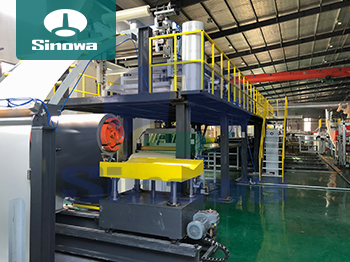


The sandwich panel machines has high adaptability, which may produce various sandwich panel of the PU, PIR and rock wool systems. We may design various products according to the customer’s requirements, including various configurations, so as to meet their demands with flexible price system. Highly integrated and linked control system centralizes all control points at the main central center, achieving parameter linkage, fault self-diagnosis controlled by the whole line and shipping distance control. High-level automatic control system also saves the manpower and reduces the manpower loss for customers.


Concentrated system control is fully realized in the practice of concentrated process control so that the control system of all the movements of the parts in the sandwich panel machines is integrated in one process control console with accessible remote communication to elevate the automation and reduce the allocated number of personnel for the assembly line. The main engine with modularized design achieves the precision operation of the sandwich panel machines, stable and reliable quality, less part and maintenance loss. The whole sandwich panel machines has over 40 innovative inventions, making our products have lots of unique features and the comprehensive performance of our sandwich panel machines leading in the industry.


The precision servo hoisting mechanism employed by the main engine without hydraulic system makes the board thickness control flexible and the customer may conveniently change or adjust the board thickness. There will be not such troubles as hydraulic system adjustment, leakage, maintenance, etc. High-level energy saving and protection design makes the whole sandwich panel machines possible to produce around the clock throughout the year and the customer will save huge budget. In addition, the isolated heat preservation room is constructed for warming the environment. The energy saving and protection design of our sandwich panel machines may guarantee that the customer’s production line may be freely heated and produce in the main time to save more costs for customers.


The high-power low-consumption design quickens the reaction of the sandwich panel machines while energy consumption is kept low. With the brand-new, fully sealed inner insulation design, the energy consumption is controlled at the minimum level to achieve the design objective of less than an hour for the insulation system to be activated from the room temperature above 5℃ to the production process temperature. The energy consumption is only 40% that of those similar products.
In the realm of modern construction and industrial manufacturing, the pursuit of efficiency, sustainability, and structural performance has driven the continuous innovation of production equipment. Among these, sandwich panel machines stand out as pivotal assets, enabling the mass production of composite panels that balance lightweight properties with exceptional strength, thermal insulation, and soundproofing capabilities. Sandwich panels, composed of two outer facings and a core material, have become indispensable in diverse sectors, from commercial buildings and industrial warehouses to cold storage facilities and modular housing.
To understand the significance of sandwich panel machines, it is first essential to grasp the basic composition of the products they manufacture. Sandwich panels consist of three layers: two thin, rigid outer sheets (known as facings) and a thicker, lightweight core material. The facings are typically made of metal (such as steel or aluminum), plastic, or fiber cement, providing structural rigidity and protection. The core, which is the key to the panel’s functional properties, can be polyurethane (PU) foam, expanded polystyrene (EPS), rock wool, glass wool, or other insulating materials. The primary function of sandwich panel machines is to automate the process of cutting, shaping, and bonding these three layers into a unified structure, ensuring consistency in thickness, density, and bonding strength that manual production cannot match. Unlike traditional manufacturing methods that rely on labor-intensive lamination and assembly, modern sandwich panel machines integrate multiple processes into a continuous production line, significantly enhancing efficiency and product quality.
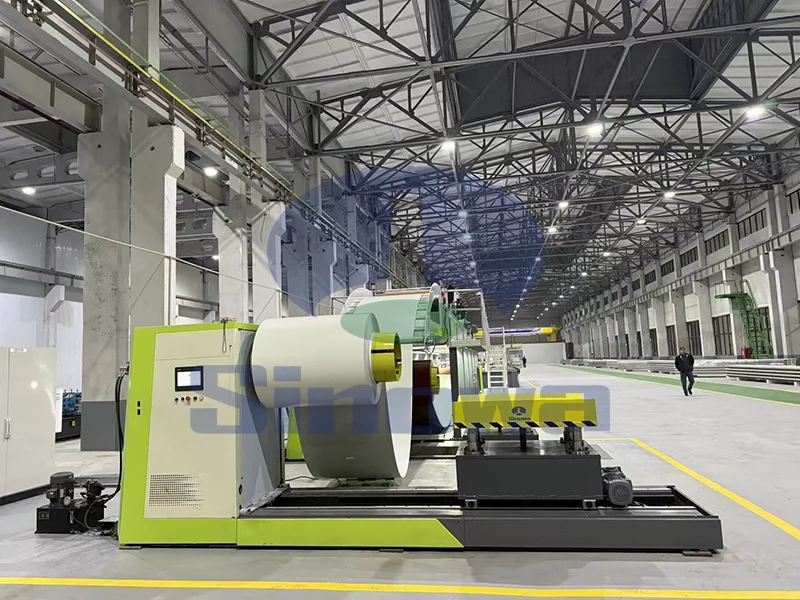
Working Principles of Sandwich Panel Machines
The working principle of sandwich panel machines varies slightly depending on the type of core material and the desired end product, but the core process follows a consistent sequence of uncoiling, forming, core filling, bonding, cooling, and cutting. This automated workflow ensures that each panel meets strict quality standards and dimensional accuracy.
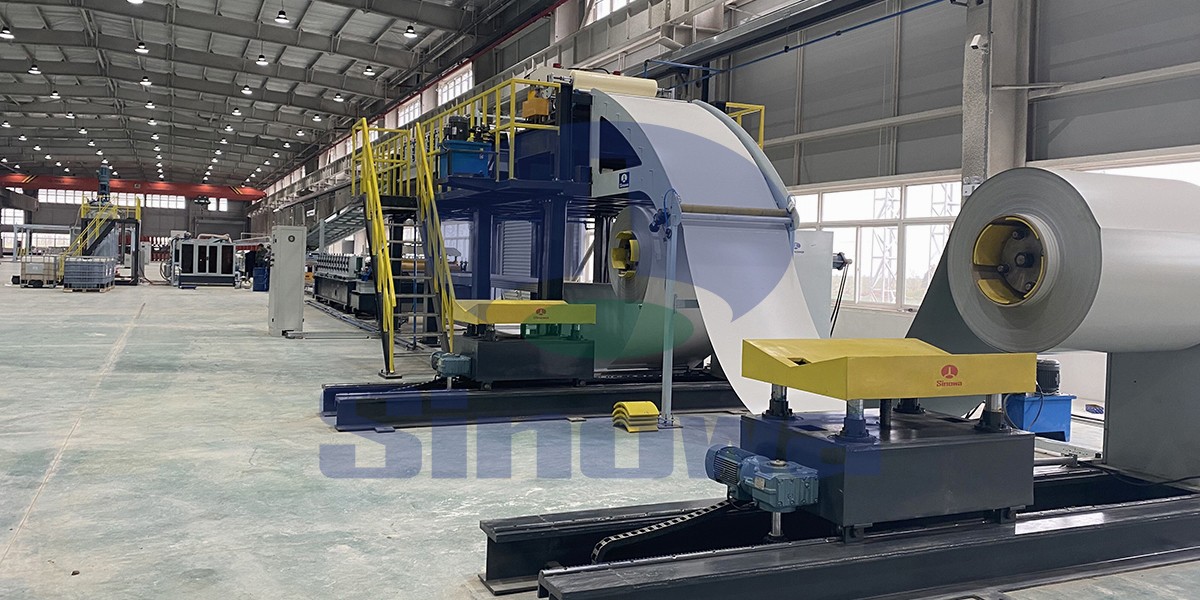
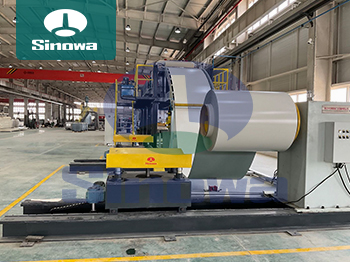
The first step in the production process is uncoiling and feeding. For metal-faced panels, large coils of steel or aluminum are loaded onto decoilers, which unroll the material and feed it into the next stage at a steady pace. Guide rollers ensure that the metal sheets remain flat and aligned, preventing wrinkles or misalignment that could affect the final product. Next comes the roll forming stage, where the metal sheets pass through a series of tandem rolling stands. Each stand applies gradual pressure to bend the sheet into the desired profile—such as corrugated, trapezoidal, or flat—without compromising the material’s structural integrity. This step is critical for ensuring that the outer facings can withstand external forces and provide adequate support for the core.
Once the outer facings are formed, the core material is introduced. The method of core application depends on the type of core: for foam cores (such as PU or EPS), liquid chemicals are mixed in a high-pressure mixer and injected between the two formed facings. The chemicals then react and expand, filling the gap between the facings and adhering to their inner surfaces. For fibrous cores (such as rock wool or glass wool), pre-formed core boards are fed into the machine and positioned between the outer sheets, after which adhesive is sprayed to ensure bonding. In both cases, the bonding process is conducted under controlled temperature and pressure conditions to ensure a strong, uniform bond between the layers.
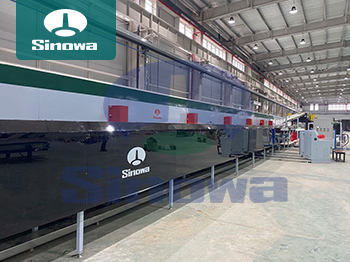
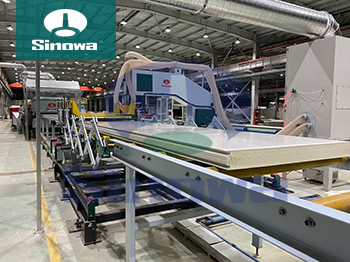
After core filling and bonding, the composite structure moves to the cooling and curing stage. For foam cores, this stage is particularly important, as the foam needs to solidify and cure to achieve its final density and structural properties. Cooling is typically accomplished using air-cooled or water-cooled rollers, which accelerate the curing process while maintaining the panel’s shape. Finally, the continuous panel is cut to the desired length by an automatic cutting machine. Advanced machines use precision cutting technologies such as band saws or circular saws, which can make cuts without stopping the production line, further enhancing efficiency. The finished panels are then automatically stacked and ready for packaging or direct shipment to construction sites.
Types of Sandwich Panel Machines
Sandwich panel machines are classified based on the type of core material they process, the level of automation, and the production method (continuous or batch). Each type is designed to cater to specific application needs and material properties, ensuring optimal performance and product quality.
Polyurethane (PU) Sandwich Panel Machines
PU sandwich panel machines are among the most widely used types, specializing in the production of panels with PU foam cores. PU foam is favored for its excellent thermal insulation, high strength-to-weight ratio, and resistance to moisture and corrosion. These machines feature a continuous production line that integrates decoiling, roll forming, PU foam injection, curing, and cutting. The key component of a PU sandwich panel machine is the high-pressure foam mixer, which ensures that the PU chemicals are mixed uniformly and injected at the correct pressure and volume. The production speed of these machines typically ranges from 3 to 8 meters per minute, with an annual capacity of up to 1 million square meters, making them ideal for large-scale construction projects.Expanded Polystyrene (EPS) Sandwich Panel Machines
EPS sandwich panel machines produce panels with EPS cores, which are known for their lightweight properties, low cost, and good thermal insulation. The working process of these machines involves pre-expanding and maturing EPS beads before filling them into the mold cavity between the outer facings. Steam heating is then used to soften and expand the beads further, causing them to bond together and form a solid core. After cooling and curing, the panels are cut to size. EPS sandwich panel machines are available in both continuous and batch production models. Continuous models are suitable for mass production, while batch models are more flexible, allowing for customization of panel sizes and shapes to meet specific project requirements.Rock Wool/Glas Wool Sandwich Panel Machines
Rock wool and glass wool are inorganic, fire-resistant materials, making panels with these cores ideal for applications where fire safety is a priority, such as industrial factories, power plants, and high-rise buildings. Rock wool sandwich panel machines integrate decoiling, roll forming, rock wool core feeding, adhesive spraying, lamination, and cutting. These machines require precise control of the adhesive application to ensure that the rock wool core is firmly bonded to the outer facings. Advanced models use digital servo technology and frequency conversion control to achieve high automation, reducing the need for manual intervention and improving production efficiency. The annual production capacity of rock wool sandwich panel machines can reach up to 800,000 square meters, making them suitable for large-scale industrial projects.Semi-Automatic vs. Fully Automatic Machines
In addition to classification by core material, sandwich panel machines are also categorized by their level of automation. Semi-automatic machines require some manual intervention, such as loading core materials or adjusting parameters during production, and are typically used by small to medium-sized manufacturers with lower production volumes. Fully automatic machines, on the other hand, integrate all production processes into a single, computer-controlled line. Operators only need to input production parameters (such as panel length, thickness, and core density) into a touchscreen interface, and the machine will complete the entire production process automatically. Fully automatic machines offer higher production speeds, better product consistency, and lower labor costs, making them the preferred choice for large-scale manufacturers and high-volume projects.
Core Advantages of Modern Sandwich Panel Machines
Modern sandwich panel machines offer a range of advantages that have made them indispensable in modern manufacturing. These advantages not only improve production efficiency but also enhance the quality and performance of the finished panels, driving their widespread adoption across industries.
First and foremost is high production efficiency. Continuous sandwich panel machines can operate at speeds of 3 to 8 meters per minute, with an annual production capacity of up to 1 million square meters. This is a significant improvement over manual production methods, which are slow, labor-intensive, and prone to errors. The automated workflow eliminates bottlenecks between processes, ensuring a steady output that can meet the demands of large-scale construction projects.
Second, sandwich panel machines ensure consistent product quality. The use of computer-controlled systems and precision components ensures that each panel has uniform thickness, density, and bonding strength. This consistency is critical for ensuring the structural integrity and functional performance of the panels. For example, in cold storage facilities, panels with uneven insulation thickness can lead to temperature fluctuations, increasing energy consumption and compromising the quality of stored goods. Modern sandwich panel machines eliminate this risk by maintaining strict control over every stage of production.
Third, these machines offer excellent flexibility and customization capabilities. By adjusting production parameters, manufacturers can produce panels of different sizes, thicknesses, and profiles to meet the specific needs of different applications. For example, a single machine can be configured to produce roof panels, wall panels, or partition panels by changing the roll forming dies and core material. This flexibility allows manufacturers to cater to a wide range of customer needs without investing in multiple specialized machines.
Fourth, sandwich panel machines contribute to sustainability and energy efficiency. The panels produced by these machines have excellent thermal insulation properties, which help reduce energy consumption in buildings by minimizing heat transfer. In addition, modern machines are designed to reduce material waste by optimizing the cutting process and ensuring precise material usage. Some advanced models also adopt eco-friendly technologies, such as fluorine-free foaming for PU cores, which reduces the environmental impact of production.
Finally, these machines reduce labor costs and improve workplace safety. Fully automatic machines require only 5 to 8 operators to run an entire production line, compared to dozens of workers needed for manual production. This not only reduces labor expenses but also minimizes the risk of workplace accidents associated with manual handling of heavy materials and operation of cutting tools.
Applications of Sandwich Panel Machines in Diverse Industries
The versatility of sandwich panels, enabled by advanced sandwich panel machines, has led to their widespread application across a range of industries. From construction and logistics to cold storage and transportation, these panels have become a preferred material for their combination of performance, efficiency, and cost-effectiveness.
In the construction industry, sandwich panels are widely used for roofing, walls, and partitions in commercial buildings, industrial warehouses, factories, and exhibition centers. Their lightweight properties reduce the load on the building’s foundation, allowing for simpler and more cost-effective structural design. At the same time, their thermal insulation and soundproofing capabilities improve the comfort and energy efficiency of buildings. For example, in industrial warehouses, rock wool sandwich panels are often used for walls and roofs due to their fire resistance and sound absorption, creating a safe and comfortable working environment. In commercial buildings such as shopping malls and office towers, PU or EPS sandwich panels are preferred for their thermal insulation, helping to reduce heating and cooling costs.
Cold storage and refrigeration is another key application area for sandwich panels produced by these machines. Cold storage facilities require materials with excellent thermal insulation to maintain low temperatures and reduce energy consumption. PU and EPS sandwich panels are ideal for this purpose, as their closed-cell foam cores have low thermal conductivity. Sandwich panel machines produce panels with precise insulation thickness and uniform bonding, ensuring that cold storage facilities can maintain stable temperatures even in extreme external conditions. These panels are also used in the production of refrigerated trucks and containers, enabling the safe transportation of perishable goods such as food, pharmaceuticals, and chemicals.
Modular housing is a rapidly growing sector that relies heavily on sandwich panel machines. Modular homes are prefabricated in factories and then assembled on-site, offering faster construction times and lower costs compared to traditional housing. Sandwich panels are used for the walls, floors, and roofs of modular homes, providing a balance of lightweight properties, structural strength, and thermal insulation. Sandwich panel machines enable the mass production of these panels, ensuring that modular housing manufacturers can meet the growing demand for affordable, sustainable housing solutions.
Other applications include agricultural buildings (such as greenhouses and livestock sheds), where sandwich panels provide thermal insulation to protect crops and animals from extreme weather conditions; and transportation infrastructure (such as highway sound barriers), where rock wool or glass wool sandwich panels are used for their soundproofing capabilities. The versatility of sandwich panels, combined with the efficiency of sandwich panel machines, has made them a staple in modern manufacturing and construction.
Future Trends in Sandwich Panel Machine Technology
As the demand for sustainable and high-performance building materials continues to grow, sandwich panel machines are poised for further innovation. Several key trends are shaping the future of these machines, focusing on improved automation, integration of smart technologies, and enhanced sustainability.
One of the most prominent trends is the integration of Industry 4.0 technologies. Smart sandwich panel machines equipped with sensors, Internet of Things (IoT) connectivity, and artificial intelligence (AI) are becoming increasingly common. These machines can monitor production parameters in real time, such as temperature, pressure, and material flow, and adjust settings automatically to optimize performance. IoT connectivity allows for remote monitoring and control, enabling manufacturers to manage production lines from anywhere, reducing downtime and improving operational efficiency. AI-powered predictive maintenance systems can also detect potential equipment failures before they occur, minimizing maintenance costs and ensuring continuous production.
Another trend is the development of machines that can process eco-friendly and recycled materials. As global attention to sustainability grows, manufacturers are seeking to reduce the environmental impact of their products. Sandwich panel machines are being adapted to process recycled core materials, such as recycled EPS foam or natural fiber cores (such as hemp or flax). In addition, machines are being designed to use low-VOC (volatile organic compound) adhesives and fluorine-free foaming agents, further reducing their environmental footprint.
Increased customization capabilities are also a key trend. As customers demand more personalized solutions, sandwich panel machines are being designed to handle a wider range of material combinations and panel profiles. Advanced machines can switch between different core materials and panel sizes quickly, enabling manufacturers to produce small batches of customized panels efficiently. This flexibility is particularly important for niche applications, such as high-end architectural projects or specialized industrial equipment.
Finally, there is a growing focus on energy efficiency in machine design. Modern sandwich panel machines are being equipped with energy-saving motors, variable frequency drives, and heat recovery systems, reducing energy consumption during production. This not only lowers operating costs for manufacturers but also aligns with global efforts to reduce carbon emissions.
Conclusion
Sandwich panel machines have evolved from simple lamination equipment to sophisticated, fully automatic production lines that play a critical role in modern manufacturing. Their ability to produce high-quality, versatile sandwich panels efficiently has made them indispensable in construction, cold storage, modular housing, and other industries. By automating the production process, these machines ensure consistent product quality, reduce labor costs, and improve workplace safety, while also contributing to sustainability through energy-efficient production and the creation of eco-friendly building materials.
As technology continues to advance, sandwich panel machines will become even more intelligent, flexible, and sustainable. The integration of Industry 4.0 technologies, the adoption of eco-friendly materials, and enhanced customization capabilities will further expand their applications and solidify their position as key assets in the global manufacturing landscape. For manufacturers, investing in advanced sandwich panel machines is not only a way to improve operational efficiency and competitiveness but also a commitment to meeting the growing demand for sustainable, high-performance building solutions in the 21st century.
《Sandwich Panel Machines》Update Date: 2026/1/8
URL: https://www.sinowamachine.cn/en/tag/sandwich-panel-machines.html
- PU Sandwich Panel Making Machine
- Rockwool Sandwich Panel Production Line
- PU Sandwich Panel Machine
- PU Sandwich Panel Production Line
- Mineral Wool Sandwich Panel Machine
- PUF Panel Machine
- Rock Wool Sandwich Panel Line
- Sandwich Panel Machines
- Sandwich Panel Lines
- Rockwool Sandwich Panel Machine
- Rockwool Sandwich Panel Line
- PU Sandwich Panel Line
- PU Panel Machine
- Foam Forming Machine
- Continuous Sandwich Panel Line
- Continuous PU Sandwich Panel Line
- PIR Sandwich Panel Line
- Polyurethane Sandwich Panel Line
- Automatic PU Sandwich Panel Production Line
- PU Foam Sandwich Panel Production Line