Continuous PU Sandwich Panel Line Manufacturer
Sinowa is continuous pu sandwich panel line supplier in china, based on the continuous technological pursuit, the continuous pu sandwich panel line developed by Sinowa provides you with high-efficiency industrial value. Based on China's cost advantage and our hard-working technology concept, our continuous pu sandwich panel line has a world-leading price-performance advantage. continuous pu sandwich panel line can meet a variety of production needs of customers.The whole continuous pu sandwich panel line design concept of modularization enables all our components to be integrated and combined at will. Our continuous pu sandwich panel line can easily automate the production of roof sandwich panel, wall sandwich panel, cold storage sandwich panel and other products by different combination and configuration selection and siple switching. The inner core layer can be polyrethane or rock wool, glass wool, an so on.
Dedicated to the research and development of high-end and high-efficiency, Sinowa is comprehensively taking the leading position in terms of efficiency, automation control level, HMI, environment protection and energy consumption, with subversive designs made in some critical technological fields to procure exceptional cost performance and customer-friendly experience for the entire continuous pu sandwich panel line. The adoption of system integration technology and bus control technology accomplishes the full automatization of integrated and coordinated control of the entire continuous pu sandwich panel line with accessible remote interactive communication. Ranking the first-class level in the world, it is currently the continuous pu sandwich panel line in the market taking a comprehensive lead in high performance.
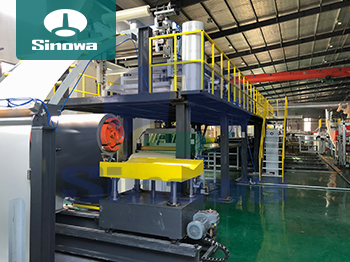


Concentrated system control is fully realized in the practice of concentrated process control so that the control system of all the movements of the parts in the continuous pu sandwich panel line is integrated in one process control console with accessible remote communication to elevate the automation and reduce the allocated number of personnel for the assembly line. The main engine with modularized design achieves the precision operation of the continuous pu sandwich panel line, stable and reliable quality, less part and maintenance loss. The whole continuous pu sandwich panel line has over 40 innovative inventions, making our products have lots of unique features and the comprehensive performance of our continuous pu sandwich panel line leading in the industry.


The continuous pu sandwich panel line has high adaptability, which may produce various sandwich panel of the PU, PIR and rock wool systems. We may design various products according to the customer’s requirements, including various configurations, so as to meet their demands with flexible price system. Highly integrated and linked control system centralizes all control points at the main central center, achieving parameter linkage, fault self-diagnosis controlled by the whole line and shipping distance control. High-level automatic control system also saves the manpower and reduces the manpower loss for customers.


The high-power low-consumption design quickens the reaction of the continuous pu sandwich panel line while energy consumption is kept low. With the brand-new, fully sealed inner insulation design, the energy consumption is controlled at the minimum level to achieve the design objective of less than an hour for the insulation system to be activated from the room temperature above 5℃ to the production process temperature. The energy consumption is only 40% that of those similar products.


The precision servo hoisting mechanism employed by the main engine without hydraulic system makes the board thickness control flexible and the customer may conveniently change or adjust the board thickness. There will be not such troubles as hydraulic system adjustment, leakage, maintenance, etc. High-level energy saving and protection design makes the whole continuous pu sandwich panel line possible to produce around the clock throughout the year and the customer will save huge budget. In addition, the isolated heat preservation room is constructed for warming the environment. The energy saving and protection design of our continuous pu sandwich panel line may guarantee that the customer’s production line may be freely heated and produce in the main time to save more costs for customers.
The continuous PU sandwich panel line stands as a sophisticated integrated manufacturing system that merges precision mechanical engineering, automated control technology, and polymer material reaction principles, serving as the core equipment for mass production of high-performance polyurethane sandwich panels in the modern construction and industrial manufacturing sectors. Unlike intermittent production equipment that relies on segmented operation and manual intervention, continuous production systems achieve seamless, uninterrupted processing from raw material feeding to finished panel output, fundamentally optimizing production efficiency, product consistency, and structural stability of finished products. As the global demand for energy-saving, lightweight, and high-strength building and industrial composite materials continues to rise, the technological maturity and operational stability of continuous PU sandwich panel production lines have become key indicators that define the quality and market competitiveness of sandwich panel products, driving iterative upgrades in the entire composite panel manufacturing industry.

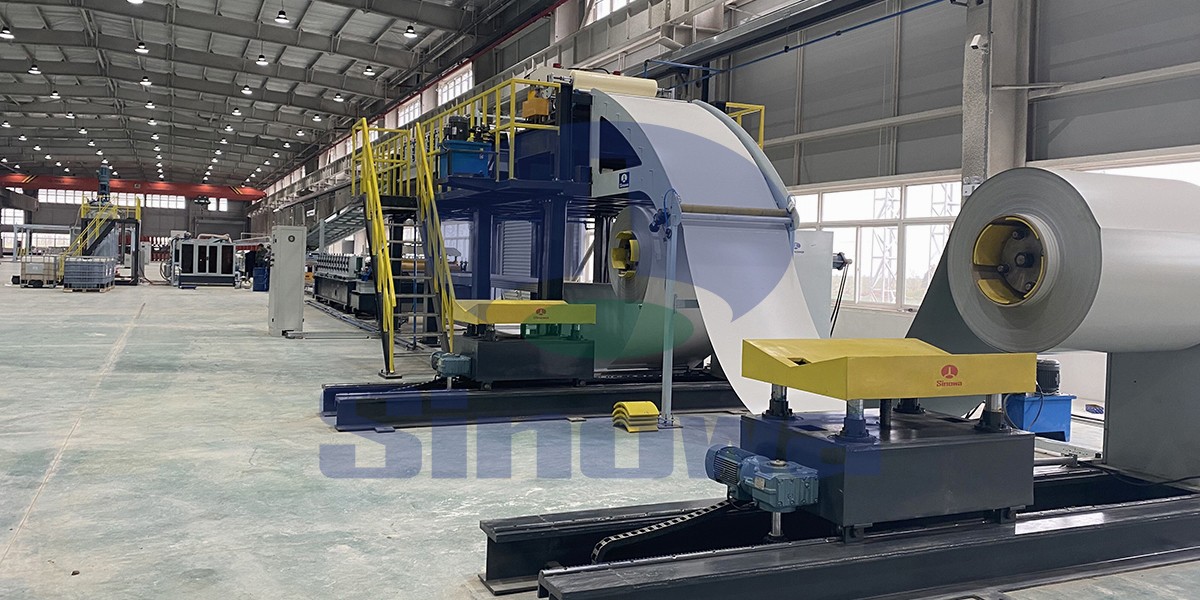
The operational logic of a modern continuous PU sandwich panel line is built on the precise coordination of multiple interconnected functional modules, each undertaking independent professional processes while maintaining synchronous linkage to eliminate production gaps and quality deviations. The entire production workflow starts with surface material pretreatment and feeding, a foundational stage that determines the flatness and structural accuracy of the final panel product. Coiled surface materials, commonly used for the outer and inner layers of sandwich panels, are released steadily through automatic unwinding units equipped with intelligent tension regulation structures. Tension control technology plays an irreplaceable role in this process, as inconsistent material tension would directly lead to surface wrinkling, material deviation, and uneven composite gaps in subsequent lamination procedures, resulting in defective finished panels. Advanced feeding systems adopt dual synchronous unwinding configurations for upper and lower surface materials, ensuring consistent feeding speed and positional alignment of double-layer materials, and laying a solid foundation for uniform composite molding in later stages.
Following stable material feeding, the surface materials enter the preheating treatment module, a critical process that optimizes the bonding performance between surface materials and PU foam core materials. In low-temperature production environments, raw surface materials often carry subtle temperature differences and surface humidity, which can hinder the chemical bonding reaction between polyurethane materials and surface substrates, causing insufficient adhesion strength and easy delamination of finished panels. The integrated preheating system of the continuous production line adopts uniform roller heating and hot air circulation heating modes, which can accurately adjust the preheating temperature according to different surface material types and production environmental conditions. This process removes residual moisture on the material surface, activates the surface molecular activity of the substrate, and greatly enhances the interfacial bonding force between the metal or non-metal surface layer and the PU foam core, effectively improving the overall structural durability and peel resistance of the sandwich panel.
The PU raw material metering, mixing, and pouring module constitutes the core functional unit of the entire production line, directly determining the foaming uniformity, density stability, and thermal insulation performance of the sandwich panel core layer. Polyurethane foam is formed by the chemical reaction of two main raw material components, and precise proportioning and high-strength mixing are essential to ensure full reaction and uniform foaming. The modern continuous production line is equipped with high-precision dynamic metering units that can realize continuous and stable proportional supply of different raw material components, avoiding quality fluctuations caused by manual proportioning errors. The high-pressure mixing device adopts a closed mixing structure, which completes instantaneous and uniform mixing of raw materials through high-speed fluid collision, ensuring that each component is fully fused without dead angles. The mixed PU liquid materials are poured linearly and evenly between the upper and lower preheated surface materials through a multi-point uniform pouring system, realizing continuous feeding of foam raw materials and avoiding local material accumulation or insufficient filling that often occurs in intermittent production modes.
After the completion of raw material pouring, the semi-finished composite materials enter the laminating pressing and constant-temperature curing molding stage, which is the key link to finalize the structural shape and stable performance of the sandwich panel. The laminating part consists of multiple groups of synchronous upper and lower pressing rollers and a closed molding cavity structure, which can apply uniform and constant pressure to the composite materials during the foaming reaction process. The foaming process of polyurethane materials is accompanied by rapid volume expansion and internal pressure generation, and the constant-pressure pressing system can effectively constrain the free expansion of foam, ensuring that the core layer forms a dense and uniform cellular structure, and the overall thickness of the panel remains consistent. The double-track synchronous transmission structure of the production line maintains stable transmission speed while bearing the foaming pressure, preventing material displacement and panel deformation during the curing process.
The constant-temperature curing system matched with the laminating unit further optimizes the foam reaction environment through precise temperature control. The independent hot air circulation circuit inside the curing area can adjust the internal temperature in real time according to production speed and panel thickness specifications, ensuring that the polyurethane foaming and curing reactions are completed in the optimal temperature range. Sufficient and constant-temperature curing enables the foam molecular structure to form stably, effectively improving the compressive strength, thermal insulation performance, and dimensional stability of the core layer. Compared with traditional static curing processes, the continuous dynamic curing mode avoids incomplete local reaction, uneven foam density, and long production cycle problems, realizing integrated molding and rapid performance stabilization of composite panels.
After completing curing and molding, the continuous sandwich panel semi-finished products enter the fixed-length cutting and finishing module. The intelligent fixed-length cutting system adopts high-precision servo positioning technology, which can automatically identify and set cutting dimensions according to production parameter settings, realizing accurate fixed-length cutting of continuous long panels. The cutting equipment is designed with high-speed and smooth cutting structures to ensure flat and burr-free panel sections, avoiding edge deformation and material damage during cutting. Meanwhile, the online finishing unit can complete edge trimming and surface defect inspection of the cut panels, removing residual edge materials and unqualified products generated in the production process, ensuring the uniformity and aesthetic consistency of the overall specifications of finished panels.
The final stage of the production process includes cooling conveying and automatic stacking, which completes the final shaping and standardized collection of finished panels. The just-cut panels still retain residual curing temperature, and the natural cooling conveying system adopts segmented slow cooling design to avoid rapid temperature change causing internal stress concentration and panel warping deformation. After full cooling and shaping, the finished panels are automatically transported to the stacking station, and the intelligent stacking device realizes orderly stacking and arrangement of panels according to set specifications, reducing manual handling links and avoiding surface scratches and structural damage caused by human contact. The whole process from feeding to stacking realizes full automatic cycle operation, with no need for manual intervention in the middle links, greatly improving production continuity and standardization.
The core advantages of the continuous PU sandwich panel production line in industrial production are reflected in three key dimensions: production efficiency, product quality stability, and production flexibility. In terms of production efficiency, the fully continuous operation mode eliminates the waiting time for material loading and unloading, mold closing and opening in intermittent production, and the integrated streamlined operation greatly improves the unit time output of panels. The synchronous operation of each functional module realizes seamless connection of processes, making the production cycle of a single panel greatly shortened, which is suitable for large-scale, batch order production demands. In terms of quality stability, the full-process automated control and precise parameter adjustment eliminate the uncertainty of manual operation. From raw material proportioning, foaming pressure, curing temperature to cutting size, all production parameters are controlled in real time by the system, ensuring that the density, thickness, bonding strength, and thermal insulation performance of each batch of panels remain highly consistent, effectively reducing the rate of defective products.
Production flexibility is another prominent feature of modern continuous PU sandwich panel machine. The equipment system supports rapid switching of production parameters, which can adapt to the production of sandwich panels with different thicknesses, surface material types, and performance specifications. By adjusting the metering ratio of PU raw materials, pressing pressure, and curing temperature parameters, the line can produce panels with different thermal insulation grades and structural strength, meeting the diverse application needs of different scenarios. Whether it is thin lightweight panels for indoor partition facilities or thick high-insulation panels for external wall thermal insulation and cold storage engineering, the continuous production line can complete efficient and standardized production through simple parameter adjustment, realizing multi-purpose use of one line and greatly improving the utilization rate of production equipment.
In terms of structural design and operational performance, modern continuous sandwich panel production lines also take energy saving and environmental protection as important design concepts. The closed PU raw material mixing and pouring structure effectively prevents the volatilization and waste of chemical raw materials, improving the utilization rate of raw materials. The circulating hot air curing system reduces energy consumption by recycling heat energy, avoiding the energy waste of traditional single heating modes. At the same time, the automated closed production environment reduces the generation of production dust and residual materials, making the whole production process more environmentally friendly and in line with the sustainable development requirements of the modern manufacturing industry. In addition, the equipment is equipped with intelligent fault self-detection and early warning functions, which can monitor the operating state of each module in real time, timely identify abnormal problems such as material blockage, parameter deviation, and equipment jitter, and feed back early warning information to the control terminal, facilitating timely maintenance and adjustment by operators and ensuring long-term stable operation of the production line.
With the continuous upgrading of downstream application industries, the technical iteration speed of continuous PU sandwich panel manufacturing line is also accelerating. In the field of construction engineering, the increasing requirements for building energy conservation, fire resistance, and structural stability have promoted the continuous optimization of production line processes. The optimized foaming process enables the PU core layer to have finer and more uniform cellular structure, further improving the thermal insulation and sound insulation performance of the panel. The upgraded lamination and curing technology enhances the overall structural tightness of the panel, making the product have better wind resistance, pressure resistance, and aging resistance, and adapting to the complex and changeable outdoor engineering application environment. In the field of industrial facilities such as cold storage, purification workshops, and industrial workshops, the high-precision production advantage of continuous lines ensures that the panel has excellent sealing and thermal insulation effects, effectively reducing the energy consumption of facility operation and improving the operational stability of industrial environments.
In practical industrial application, the continuous PU sandwich panel making machine has become the mainstream production equipment for high-end sandwich panel products, replacing traditional intermittent production equipment with its outstanding comprehensive performance. The products produced by continuous lines have significant advantages in structural uniformity, performance stability, and service life, and are widely used in building exterior wall insulation, roof enclosure, indoor space partition, cold storage thermal insulation, industrial factory building enclosure, and mobile building facilities. The high degree of production automation not only reduces labor input and production cost for manufacturing enterprises, but also realizes standardized and large-scale production, helping enterprises improve product market adaptability and industry competitiveness.
Looking at the future development trend, the continuous PU sandwich panel line will further develop in the direction of higher intelligence, higher efficiency, and greener production. The deep integration of digital control technology and mechanical equipment will realize full-process digital monitoring and intelligent adjustment of production, making production parameter control more precise and product quality more stable. The optimized mechanical structure and process flow will further improve production speed and raw material utilization efficiency, meeting the growing market demand for high-volume and high-standard sandwich panels. At the same time, with the continuous improvement of environmental protection production standards, the production line will continue to optimize energy-saving and emission-reduction technologies, realize cleaner and low-consumption production, and provide more reliable and environmentally friendly equipment support for the sustainable development of the composite panel manufacturing industry. As a key core equipment in the new material manufacturing field, the continuous PU sandwich panel line will continue to drive the technological progress and industrial upgrading of the sandwich panel industry, and provide high-quality composite material solutions for the construction, industrial manufacturing, and new energy fields.
《Continuous PU Sandwich Panel Line Manufacturer》Update Date: 2026/7/10
Tags: Continuous PU Sandwich Panel Line , Discontinuous PU Sandwich Panel Line ,
URL: https://www.sinowamachine.cn/en/blog/continuous-pu-sandwich-panel-line-manufacturer.html
- High-quality PU Board Production Line
- Continuous PU Sandwich Panel Line Manufacturing
- Automatic PU Sandwich Panel Production Line
- PU Panel Machine Manufacturer
- PUF Panel Machine For House
- High-end PU Insulation Panel Line
- PU Panel Machine For Sale
- Low Price PUF Panel Making Machine
- Continuous PU Sandwich Panel Line For Wall
- PUF Panel Machine For Roof
- Continuous PU Sandwich Panel Line For Sale
- Continuous PU Sandwich Panel Line For Roof
- PU Panel Machine Factory
- Continuous PU Sandwich Panel Line For House
- PUF Panel Machine Manufacturer
- Continuous PU Sandwich Panel Line Factory
- Decorative PU Sandwich Panel Machine Design
- Continuous PU Sandwich Panel Line Design
- High-end Decorative PU Sandwich Panel Machine
- Continuous PU Sandwich Panel Line On Sales
- PU Sandwich Panel Making Machine
- Rockwool Sandwich Panel Production Line
- PU Sandwich Panel Machine
- PU Sandwich Panel Production Line
- Mineral Wool Sandwich Panel Machine
- PUF Panel Machine
- Rock Wool Sandwich Panel Line
- Sandwich Panel Machines
- Sandwich Panel Lines
- Rockwool Sandwich Panel Machine
- Rockwool Sandwich Panel Line
- PU Sandwich Panel Line
- PU Panel Machine
- Foam Forming Machine
- Continuous Sandwich Panel Line
- Continuous PU Sandwich Panel Line
- PIR Sandwich Panel Line
- Polyurethane Sandwich Panel Line
- Automatic PU Sandwich Panel Production Line
- PU Foam Sandwich Panel Production Line