Sandwich Panel Production Line
Sinowa is sandwich panel production line manufacturer from china, dedicated to the research and development of high-end and high-efficiency, Sinowa is comprehensively taking the leading position in terms of efficiency, automation control level, HMI, environment protection and energy consumption, with subversive designs made in some critical technological fields to procure exceptional cost performance and customer-friendly experience for the entire sandwich panel production line. The adoption of system integration technology and bus control technology accomplishes the full automatization of integrated and coordinated control of the entire sandwich panel production line with accessible remote interactive communication. Ranking the first-class level in the world, it is currently the sandwich panel production line in the market taking a comprehensive lead in high performance.
Based on the continuous technological pursuit, the sandwich panel production line developed by Sinowa provides you with high-efficiency industrial value. Based on China's cost advantage and our hard-working technology concept, our sandwich panel production line has a world-leading price-performance advantage. sandwich panel production line can meet a variety of production needs of customers.The whole sandwich panel production line design concept of modularization enables all our components to be integrated and combined at will. Our sandwich panel production line can easily automate the production of roof sandwich panel, wall sandwich panel, cold storage sandwich panel and other products by different combination and configuration selection and siple switching. The inner core layer can be polyrethane or rock wool, glass wool, an so on.
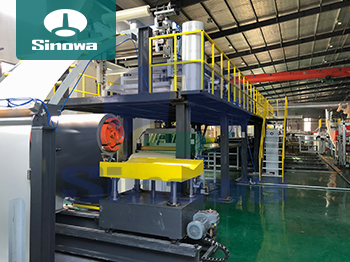


The sandwich panel production line has high adaptability, which may produce various sandwich panel of the PU, PIR and rock wool systems. We may design various products according to the customer’s requirements, including various configurations, so as to meet their demands with flexible price system. Highly integrated and linked control system centralizes all control points at the main central center, achieving parameter linkage, fault self-diagnosis controlled by the whole line and shipping distance control. High-level automatic control system also saves the manpower and reduces the manpower loss for customers.


Concentrated system control is fully realized in the practice of concentrated process control so that the control system of all the movements of the parts in the sandwich panel production line is integrated in one process control console with accessible remote communication to elevate the automation and reduce the allocated number of personnel for the assembly line. The main engine with modularized design achieves the precision operation of the sandwich panel production line, stable and reliable quality, less part and maintenance loss. The whole sandwich panel production line has over 40 innovative inventions, making our products have lots of unique features and the comprehensive performance of our sandwich panel production line leading in the industry.


The precision servo hoisting mechanism employed by the main engine without hydraulic system makes the board thickness control flexible and the customer may conveniently change or adjust the board thickness. There will be not such troubles as hydraulic system adjustment, leakage, maintenance, etc. High-level energy saving and protection design makes the whole sandwich panel production line possible to produce around the clock throughout the year and the customer will save huge budget. In addition, the isolated heat preservation room is constructed for warming the environment. The energy saving and protection design of our sandwich panel production line may guarantee that the customer’s production line may be freely heated and produce in the main time to save more costs for customers.


The high-power low-consumption design quickens the reaction of the sandwich panel production line while energy consumption is kept low. With the brand-new, fully sealed inner insulation design, the energy consumption is controlled at the minimum level to achieve the design objective of less than an hour for the insulation system to be activated from the room temperature above 5℃ to the production process temperature. The energy consumption is only 40% that of those similar products.
Sandwich panels have become indispensable materials in modern architecture and industrial applications, thanks to their unique combination of light weight, structural strength, thermal insulation, and weather resistance. These composite panels, typically consisting of two outer facings and a lightweight core material, owe their consistent quality and large-scale availability to the advanced sandwich panel production lines that integrate precision engineering, automated control, and sophisticated material processing technologies. The production line is a complex system of interconnected processes and equipment, each playing a crucial role in transforming raw materials into finished panels that meet the diverse needs of construction, cold storage, industrial warehousing, and other sectors. Understanding the intricacies of these production lines not only sheds light on the manufacturing of a key building material but also reflects the broader trends of industrial automation, energy efficiency, and sustainable construction.
At the core of any sandwich panel production line lies a sequence of well-coordinated stages, starting from raw material preparation and proceeding through panel formation, curing, cutting, and finishing. Each stage is designed to ensure the integrity of the panel's structure, where the outer facings and core material are bonded into a unified composite with consistent performance characteristics. The choice of raw materials varies depending on the intended application of the panels, with outer facings often including galvanized steel, aluminum, or fiber-reinforced polymers, and core materials ranging from polyurethane (PU) foam, polyisocyanurate (PIR) foam, and expanded polystyrene (EPS) to mineral wool and glass wool. The production line must be adaptable to these different materials, adjusting processing parameters such as temperature, pressure, and speed to achieve optimal bonding and product quality.
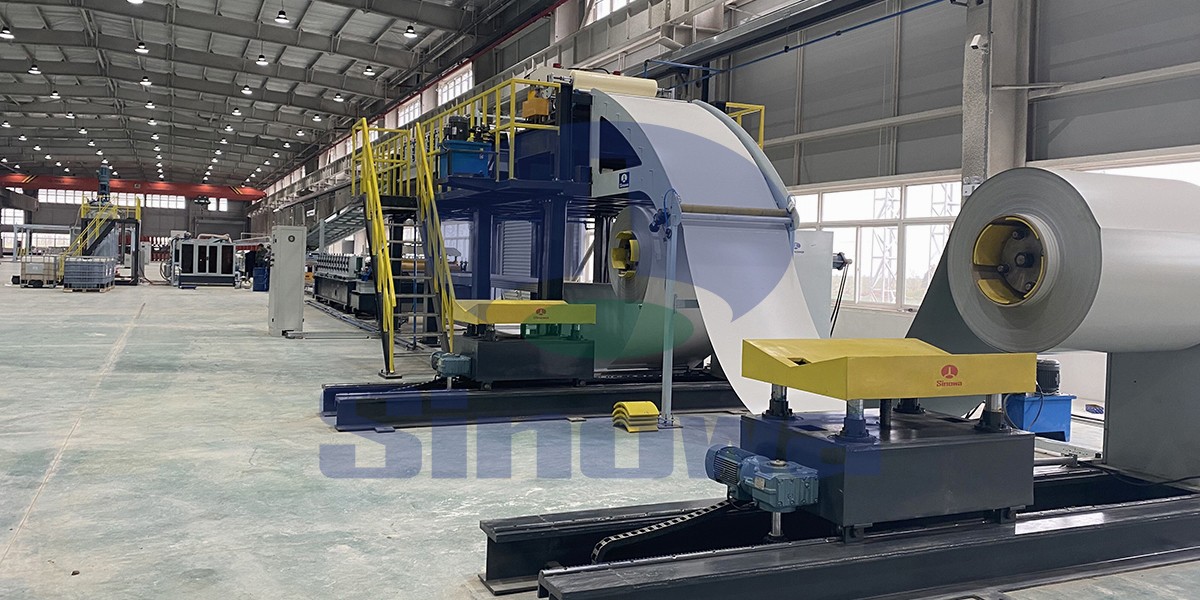
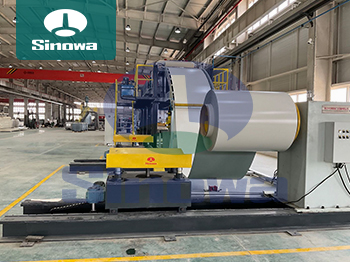
Raw material preparation is the foundational stage of the production process, where the outer facings and core materials are prepared for assembly. For metal facings, which are the most common choice in industrial and commercial applications, the process begins with uncoiling large rolls of sheet metal using decoiling machines. These machines are equipped with tension control systems to ensure the metal sheet is fed smoothly without wrinkling or stretching, which could compromise the flatness of the final panel. In many cases, the metal sheets also undergo pre-treatment processes such as cleaning and pre-heating. Cleaning removes any dust, oil, or debris that might hinder adhesion, while pre-heating ensures the sheet is at an optimal temperature for bonding with the core material, particularly when using foam cores that require a specific temperature range for proper curing. Some production lines also include profiling equipment at this stage, which shapes the metal sheets into corrugated or trapezoidal forms to enhance their structural rigidity and facilitate inter-panel connection during installation.
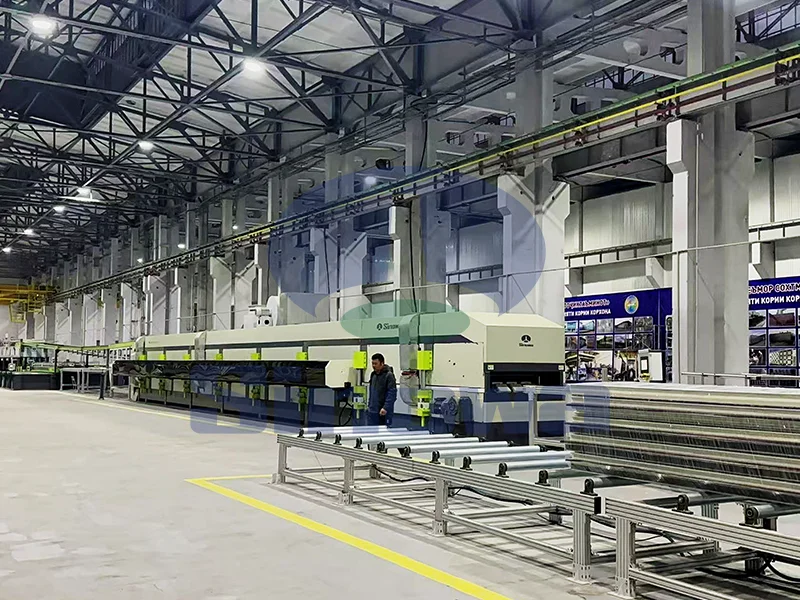
For core materials, the preparation process differs significantly based on their type. Foam cores such as PU and PIR are typically produced on-site within the production line using a foaming system, while pre-manufactured core materials like EPS, mineral wool, and glass wool are cut to the required dimensions before being fed into the assembly area. The foaming system for PU and PIR cores is a critical component of the production line, consisting of storage tanks for the raw chemical components (polyol and isocyanate), metering pumps, and a mixing head. The metering pumps deliver precise ratios of the chemical components to the mixing head, where they are combined with additives such as catalysts, flame retardants, and blowing agents. This precise metering is essential to ensure the foam achieves the desired density, thermal conductivity, and mechanical properties. The mixing head homogenizes the mixture, which is then dispensed onto the lower metal facing as it moves along the production line.
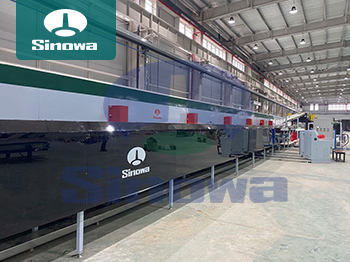
The assembly and formation stage is where the sandwich panel begins to take shape, as the prepared outer facings and core material are brought together and bonded. For foam core panels, this process is highly dynamic: the lower metal facing is fed onto a conveyor system, and the foam mixture is evenly distributed across its surface. The upper metal facing is then fed over the foam layer, and the entire assembly is passed through a double-track laminating conveyor. This conveyor consists of two parallel tracks with heated plates that apply uniform pressure and temperature to the assembly. As the panel moves through the laminating conveyor, the foam mixture undergoes a chemical reaction, expanding to fill the space between the two metal facings and curing into a rigid core. The temperature and pressure applied by the conveyor are carefully controlled to ensure complete curing of the foam, which typically takes several minutes depending on the type of foam and panel thickness. For pre-manufactured core materials, the process involves placing the cut core material onto the lower metal facing, applying an adhesive layer, and then covering it with the upper facing before passing through the laminating conveyor to ensure strong bonding.
Curing is a critical stage that determines the structural strength and durability of the sandwich panel. For foam core panels, curing occurs simultaneously with foam expansion as the assembly moves through the laminating conveyor. The heated plates of the conveyor maintain a consistent temperature, usually between 60°C and 80°C, which accelerates the chemical reaction of the foam components and ensures the core hardens into a stable structure. The length of the laminating conveyor is designed to provide sufficient time for complete curing, with longer conveyors used for thicker panels or foam formulations that require extended curing times. For panels using adhesive-bonded pre-manufactured cores, the curing stage involves maintaining the assembly at a controlled temperature and pressure to allow the adhesive to set and form a strong bond between the facings and the core. Proper curing is essential to prevent delamination, which can significantly reduce the panel's structural integrity and performance.
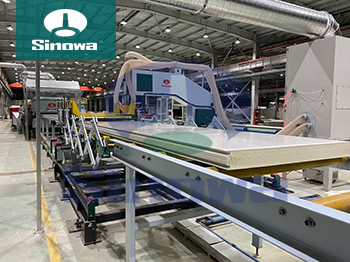
Once the panel is fully cured, it moves to the cutting stage, where it is trimmed to the required length and width. This stage uses precision cutting equipment, such as automatic tracking crosscut saws, which follow the movement of the panel to ensure accurate cutting without causing damage to the edges. The cutting parameters are controlled by a computerized system, allowing for quick adjustments to different panel dimensions based on customer requirements. In addition to length and width cutting, some production lines also include edge trimming and profiling equipment to smooth the panel edges and create specialized profiles for inter-panel connection, such as tongue-and-groove joints that enhance the panel's insulation and waterproofing performance. The cutting stage is also equipped with dust collection systems to remove any debris generated during the cutting process, maintaining a clean production environment and preventing contamination of the finished panels.
The final stage of the production process is finishing and quality control. After cutting, the panels undergo a series of inspections to ensure they meet the required quality standards. Inspectors check for dimensional accuracy, surface flatness, and the integrity of the bond between the facings and the core. For foam core panels, additional tests may be conducted to verify the foam density and thermal conductivity. Any panels that fail to meet the quality standards are rejected or sent for reworking. Once the panels pass inspection, they are prepared for packaging and storage. Packaging typically involves wrapping the panels in protective film to prevent scratches and damage during transportation, and adding corner protectors to reinforce the edges. The finished panels are then stacked on pallets and stored in a warehouse, ready for delivery to customers.
Modern sandwich panel production lines are characterized by a high degree of automation, which plays a key role in improving production efficiency, reducing labor costs, and ensuring consistent product quality. Automated systems control every stage of the production process, from raw material feeding and foam mixing to cutting and quality inspection. Computerized control systems allow operators to monitor and adjust processing parameters in real-time, responding quickly to any deviations from the desired specifications. For example, if the foam density is found to be outside the required range, the control system can automatically adjust the metering pumps to correct the ratio of chemical components. Some advanced production lines also integrate artificial intelligence (AI) and machine vision technologies for quality control, using cameras and sensors to detect surface defects, edge irregularities, and bonding issues that may be missed by human inspectors.
Another important feature of modern sandwich panel production lines is their adaptability to different panel configurations and materials. As the demand for specialized sandwich panels grows, production lines must be able to handle a wide range of outer facings and core materials, as well as varying panel thicknesses and dimensions. For example, panels used in cold storage facilities require high-performance insulation cores such as PU or PIR foam, while panels used in fire-sensitive applications need fire-resistant cores like mineral wool. Production lines are designed with modular components that can be easily reconfigured to accommodate these different requirements. For instance, the foaming system can be adjusted to produce different types of foam cores, and the laminating conveyor can be modified to handle varying panel thicknesses by adjusting the distance between the upper and lower tracks.
Energy efficiency and sustainability are also becoming increasingly important considerations in the design and operation of sandwich panel production lines. Manufacturers are adopting a range of measures to reduce energy consumption, such as using energy-efficient motors and heating systems, and implementing heat recovery systems to reuse waste heat from the curing process. In terms of sustainability, production lines are being designed to use more environmentally friendly materials, such as recycled metal facings and bio-based foam cores. Additionally, efforts are being made to reduce waste generation, with scrap materials from cutting and trimming being collected and recycled. For example, metal scrap is sent for recycling, and foam scrap is reused as raw material for other products or processed into insulation materials.
The performance of a sandwich panel production line directly impacts the quality and functionality of the finished panels, which in turn determines their suitability for different applications. In industrial settings, such as warehouses and manufacturing facilities, sandwich panels produced by high-quality lines are valued for their lightweight yet robust structure, which reduces the overall weight of the building and lowers construction costs. In cold storage and refrigeration units, the thermal insulation properties of the panels are critical, and production lines must ensure the foam core is evenly distributed and fully cured to achieve the required thermal conductivity. In commercial buildings, such as shopping centers and office buildings, the aesthetic appearance of the panels is also important, requiring production lines to maintain consistent surface quality and color matching of the outer facings.
Looking to the future, the development of sandwich panel production lines is likely to be driven by several key trends. One of the most significant trends is the continued advancement of automation and digitalization, with more production lines integrating IoT (Internet of Things) technologies to enable remote monitoring and predictive maintenance. This will allow manufacturers to optimize production processes, reduce downtime, and improve overall operational efficiency. Another trend is the growing focus on green and sustainable manufacturing, with the adoption of more eco-friendly materials and processes to meet the increasing demand for sustainable building solutions. For example, the development of bio-based PU foam cores and fully recyclable sandwich panels is expected to drive innovations in production line design.
Additionally, the demand for customized sandwich panels is expected to grow, requiring production lines to be even more flexible and adaptable. This may lead to the development of modular production lines that can be quickly reconfigured to produce panels with different dimensions, materials, and performance characteristics. Furthermore, as building standards become more stringent, particularly in terms of energy efficiency and fire safety, production lines will need to be capable of producing panels that meet these higher standards, driving advancements in material processing and quality control technologies.
In conclusion, the sandwich panel production line is a sophisticated and integrated system that plays a vital role in the manufacturing of a key building material for modern construction. From raw material preparation to finishing and quality control, each stage of the production process is designed to ensure the consistency, performance, and reliability of the finished panels. With the ongoing advancements in automation, digitalization, and sustainable manufacturing, these production lines are evolving to meet the changing needs of the construction industry, enabling the production of more efficient, durable, and environmentally friendly sandwich panels. As the demand for sustainable and energy-efficient building solutions continues to grow, the importance of advanced sandwich panel production lines will only increase, making them a critical component of the global construction supply chain.
《Sandwich Panel Production Line》Update Date: 2026/1/15
URL: https://www.sinowamachine.cn/en/tag/sandwich-panel-production-line.html
- PU Sandwich Panel Making Machine
- Rockwool Sandwich Panel Production Line
- PU Sandwich Panel Machine
- PU Sandwich Panel Production Line
- Mineral Wool Sandwich Panel Machine
- PUF Panel Machine
- Rock Wool Sandwich Panel Line
- Sandwich Panel Machines
- Sandwich Panel Lines
- Rockwool Sandwich Panel Machine
- Rockwool Sandwich Panel Line
- PU Sandwich Panel Line
- PU Panel Machine
- Foam Forming Machine
- Continuous Sandwich Panel Line
- Continuous PU Sandwich Panel Line
- PIR Sandwich Panel Line
- Polyurethane Sandwich Panel Line
- Automatic PU Sandwich Panel Production Line
- PU Foam Sandwich Panel Production Line