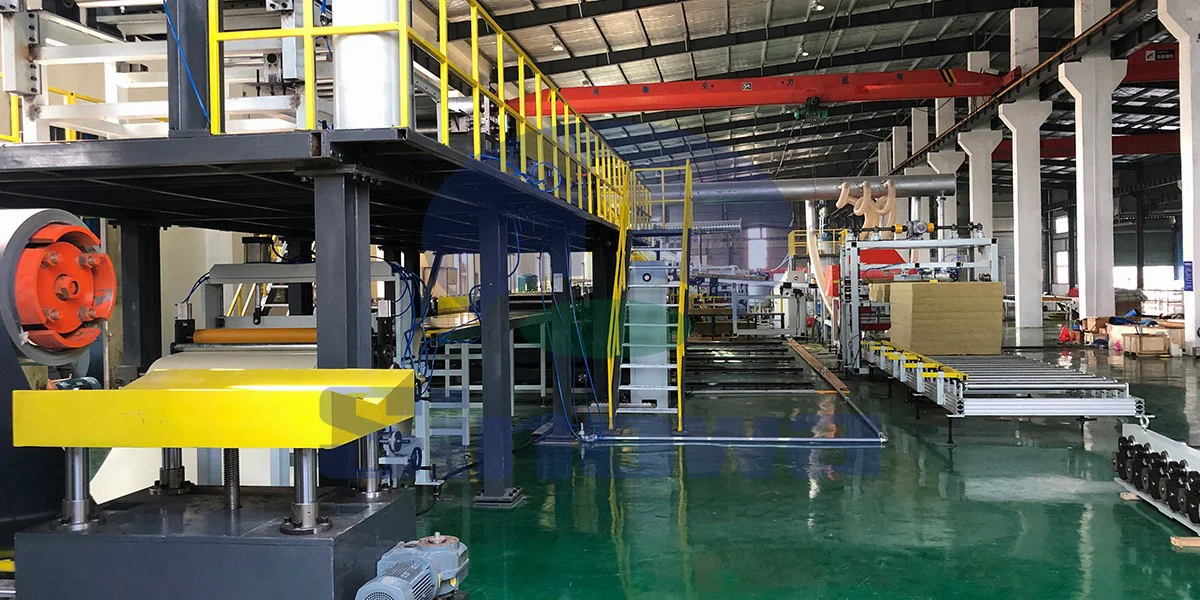
Fully Automatic Rock Wool Sandwich Panel Machine
Fully Automatic Rock Wool Sandwich Panel Machine from China factory. PLC continuous line for fireproof insulated rock wool wall & roof panels. Low labor, stable running, custom sizes available.

Overview of Sandwich Panel Plants
This fully automatic rock wool sandwich panel machine is an integrated continuous production line. It realizes automatic unwinding, gluing, compound pressing, curing, fixed-length cutting and stacking with minimal manual work. It can produce flat or profiled rock wool sandwich wall and roof panels widely used in prefabricated buildings, workshops and clean areas. Adopting centralized programmable control, it ensures stable bonding quality and high yield. The line supports flexible specification switching, and complete installation guidance, operator training and long-term technical support are available.
Sinowa fully automatic rock wool sandwich panel machine reaches world-class standards in equipment efficiency, automatic control, HMI, environmental protection and energy-saving performance. It adopts disruptive key technologies and delivers excellent cost-performance, supporting remote interactive communication.
-
![Fully Automatic Rock Wool Sandwich Panel Machine]() Modular Design: The fully automatic rock wool sandwich panel machine features modular design with freely combinable and interchangeable components. Core parts are machined by machining centers to minimize human-factor interference. It achieves high production efficiency and fast delivery with low maintenance loss. The sandwich panel equipment owns more than 40 innovative patented technologies.
-
![Fully Automatic Rock Wool Sandwich Panel Machine]() Multi-product Manufacturing Capacity: It can automatically produce roof, wall and cold-storage sandwich panels via configuration switching. It supports sandwich panels with core materials including PU, PIR, rock wool and glass wool. Custom configurations and flexible pricing packages are available upon customer requirements.
-
![Fully Automatic Rock Wool Sandwich Panel Machine]() Control System Advantages: Highly integrated and linked control system centralizes all control points on the main console. Functions including parameter linkage, full-line fault self-diagnosis, conveying distance control and remote communication are available to greatly cut manpower input.
-
![Fully Automatic Rock Wool Sandwich Panel Machine]() Main Machine Features: The main engine adopts a precision servo hoisting mechanism without hydraulic system. Board thickness can be adjusted flexibly and conveniently, avoiding common troubles of hydraulic systems such as leakage, commissioning and maintenance, ensuring precise operation and stable product quality.
-
![Fully Automatic Rock Wool Sandwich Panel Machine]() Energy-saving & Environmental-friendly Performance: Equipped with an independent heating-insulation room and brand-new fully-sealed inner insulation structure. It supports round-the-clock production all year round. The insulation system can heat up from ambient temperature above 5℃ to process temperature within less than one hour. Its energy consumption is only 40% of similar products, which greatly reduces production costs.
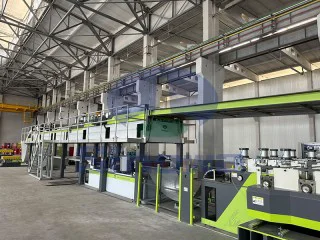
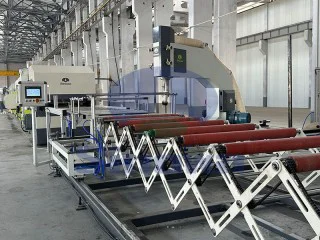
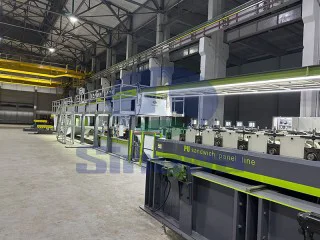
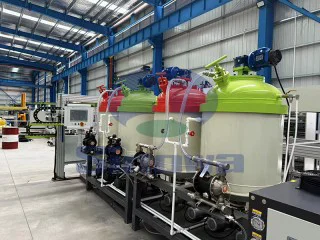
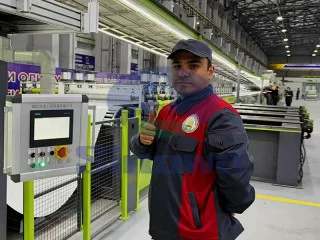

Main Technical Parameters of Sandwich Panel Machinery
- Production types: PU, PIR, phenolic, rockwool panels
- Production usage: insulation panels, decorative panels
- Sheet surface options: aluminum foil, non-woven fabric, paper, naked surface
- Product thickness: 10m -200 mm
- Production speed: 3.0m - 25m
- Foaming method: two or multi-component foaming
- Foaming agent: pentane or 141B
- Line length: 45m -100m, Customer Optional
The fully automatic rock wool sandwich panel machine is a continuous integrated production line dedicated to forming composite sandwich panels with rock wool as the core insulation material. It realizes automatic material feeding, continuous forming, compound pressing, cutting and stacking in one streamlined workflow, greatly reducing manual intervention in panel manufacturing. As a specialized composite board production equipment, it balances thermal insulation performance, structural strength and production efficiency to meet the large-volume market demand for fire-resistant building composite panels.
Working Principle
This production equipment relies on continuous rolling and hot composite bonding technology. The rock wool core material is conveyed steadily into the composite station after pre-treatment. Meanwhile, upper and lower metal facing sheets are unwound, leveled and pre-formed into preset profiles. Adhesive is evenly coated on the bonding surfaces of the rock wool core and metal sheets through an automatic gluing system. Under constant pressure and suitable temperature inside the curing section, the rock wool core and two surface sheets are tightly bonded into an integral composite board. After curing, the continuous panel strip is automatically cut into required lengths, followed by edge trimming and finished product stacking. The whole bonding process ensures consistent adhesion strength between the core layer and facings, avoiding delamination and gaps.
Main Machine Components
The complete production line consists of multiple functional units that coordinate with each other. The raw material unwinding unit holds metal coils and feeds facings continuously. The rock wool feeding and arranging unit sorts and conveys rock wool strips, adjusting core material layout to guarantee uniform filling. Next comes the automatic gluing unit, which controls glue dosage and spraying range precisely. The continuous pressing and curing host provides stable pressure and curing environment for composite forming. A follow-up cutting unit carries off-line fixed-length cutting, and the trimming mechanism removes irregular edges. In addition, the line includes a conveying transition system, finished panel stacking device, waste collection structure and safety protection components. All units are linked synchronously to avoid production pause caused by mismatched running speed.
Production Process Flow
The standardized production flow starts with raw material preparation: metal coils are loaded on unwinding racks and rock wool core materials are arranged neatly. Metal facings pass through leveling and embossing stations to obtain required surface shapes. Rock wool cores are transported to the gluing area, where adhesive is applied uniformly. Then the rock wool core is sandwiched between upper and lower metal sheets and enters the pressing and curing tunnel for integrated compounding. After sufficient curing, the continuous panel moves forward to the cutting station for fixed-length cutting according to preset parameters. Trimming removes uneven side edges, and finished panels are conveyed to the stacking area for automatic stacking. Inspection can be arranged between cutting and stacking to screen out defective products, and leftover scraps are collected for centralized processing.
Available Panel Types and Application Scenarios
Supported finished panels mainly include rock wool metal sandwich panels with flat or profiled metal surfaces. It can produce panels with different rock wool core densities and customized thickness specifications. Some adjustable configurations also allow the production of matched rock wool wall panels and roof panels with different joint structures. These panels are widely adopted in the enclosure systems of prefabricated buildings, factory workshops, large logistics warehouses and clean working areas. They are also commonly used for partition walls of indoor fire-isolation zones, temporary modular buildings and thermal-insulated roofing structures. The composite panels combine fire resistance and heat preservation, making them suitable for spaces with high requirements on thermal insulation and fire prevention.
Equipment Advantages and Characteristics
The fully automatic rock wool sandwich panel production line features high continuous production capacity and stable operation rhythm. It reduces dependence on manual operation, lowering human error in gluing, compounding and sizing. The pressure and speed parameters can be adjusted flexibly to adapt to different core material thicknesses and facing materials. The integrated structural design saves workshop layout space and simplifies material transfer links. The pressing system maintains even pressure distribution across the whole panel width, which effectively improves the yield rate of finished boards. The line runs with low noise, and the waste recycling structure helps reduce raw material waste. Besides, the equipment supports quick specification switching, so manufacturers can adjust panel sizes to satisfy diversified order demands without lengthy refitting.
Control System and Quality Control
The whole line is equipped with a centralized programmable control system. Operators set production parameters such as line speed, cutting length, gluing flow and curing time on the human-machine interaction interface. Synchronous linkage of all drive motors is realized through the control program to keep consistent running speed of every section. Real-time monitoring modules track working status of key components, and abnormal signals will trigger prompt alarms. For quality control, the system records production data of each batch. Fixed-length cutting accuracy is guaranteed by the encoder positioning structure. Regular online sampling checks focus on bonding condition, panel flatness and dimension deviation. Parameter locking function prevents arbitrary modification by unauthorized personnel, helping maintain stable and repeatable panel quality.
Installation, Matching and After-sales Service
Before installation, a site layout plan will be provided to match the customer’s workshop space, including foundation requirements, power supply configuration and reserved operation channels. Professional guidance is available for equipment hoisting, assembly, pipeline connection and initial debugging. Auxiliary supporting facilities include power distribution cabinets, exhaust devices for curing sections and waste conveying accessories. After equipment handover, operation training is provided for on-site operators, covering standard startup, parameter adjustment, daily inspection and simple fault troubleshooting. Long-term after-sales support covers remote technical consultation for operational failures and guidance on regular maintenance plans. Spare part supply channels are reserved for vulnerable consumable components to minimize production downtime when replacement is needed. Routine maintenance suggestions are offered to extend the service life of the whole production line.
- Continuous PU Sandwich Panel Line
- Glass Wool Sandwich Panel Production Line
- Insulation Board Production Line
- Mineral Wool Sandwich Panel Production Line
- PIR Sandwich Panel Production Line
- Polyurethane Sandwich Panel Line
- Polyurethane Sandwich Panel Machine
- Polyurethane Sandwich Panel Manufacturing Line
- Polyurethane Sandwich Panel Production Line
- PU Sandwich Panel Line
- PU Sandwich Panel Machine
- PU Sandwich Panel Production Line
- PUR Sandwich Panel Production Line
- Rock Wool Sandwich Panel Production Line
- Sandwich Panel Lines
- Sandwich Panel Machines
- Sandwich Panel Manufacturing Line
- Sandwich Panel Production Line
- Sandwich Panel Production Machinery
- Sandwich Panel Production Machines