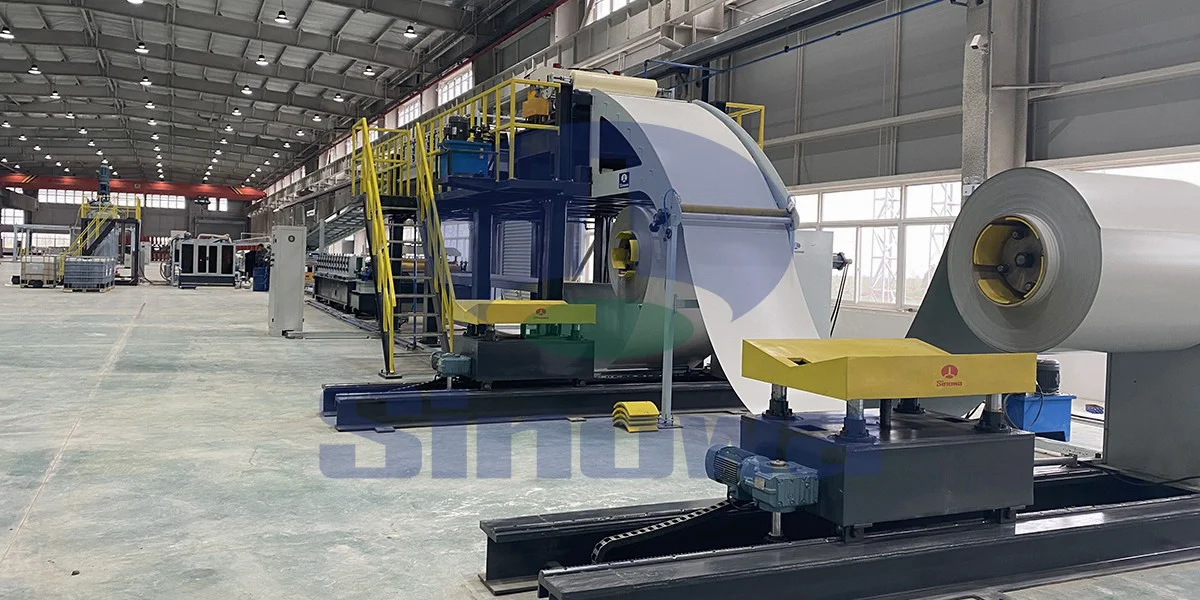
Polyurethane Sandwich Panel Machinery
China Polyurethane Sandwich Panel Machinery manufacturer. Fully automatic continuous PU sandwich panel line for insulated wall, roof & cold room panels. Stable foaming, PLC control, custom sizes available. Support custom design & overseas service.
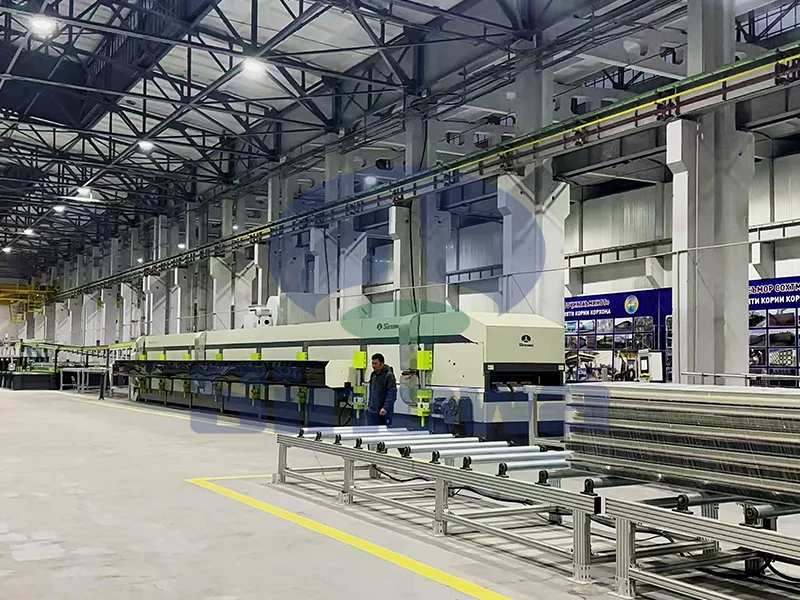
Overview of Sandwich Panel Plants
Polyurethane sandwich panel machinery is an automated continuous production line for composite insulated panels. It works based on the foaming and curing reaction of two-component polyurethane, consisting of unwinding, metering, spraying, double-belt forming, cutting and stacking units. It can make panels with metal or non-metal facings widely used in workshops, cold storage, clean rooms and prefab buildings. Featuring stable forming and flexible parameter adjustment, the line adopts an integrated control system for quality monitoring. It also includes on-site installation guidance, operator training and long-term technical after-sales support.
Sinowa polyurethane sandwich panel machinery reaches world-class standards in equipment efficiency, automatic control, HMI, environmental protection and energy-saving performance. It adopts disruptive key technologies and delivers excellent cost-performance, supporting remote interactive communication.
-
![Polyurethane Sandwich Panel Machinery]() Modular Design: The polyurethane sandwich panel machinery features modular design with freely combinable and interchangeable components. Core parts are machined by machining centers to minimize human-factor interference. It achieves high production efficiency and fast delivery with low maintenance loss. The sandwich panel equipment owns more than 40 innovative patented technologies.
-
![Polyurethane Sandwich Panel Machinery]() Multi-product Manufacturing Capacity: It can automatically produce roof, wall and cold-storage sandwich panels via configuration switching. It supports sandwich panels with core materials including PU, PIR, rock wool and glass wool. Custom configurations and flexible pricing packages are available upon customer requirements.
-
![Polyurethane Sandwich Panel Machinery]() Control System Advantages: Highly integrated and linked control system centralizes all control points on the main console. Functions including parameter linkage, full-line fault self-diagnosis, conveying distance control and remote communication are available to greatly cut manpower input.
-
![Polyurethane Sandwich Panel Machinery]() Main Machine Features: The main engine adopts a precision servo hoisting mechanism without hydraulic system. Board thickness can be adjusted flexibly and conveniently, avoiding common troubles of hydraulic systems such as leakage, commissioning and maintenance, ensuring precise operation and stable product quality.
-
![Polyurethane Sandwich Panel Machinery]() Energy-saving & Environmental-friendly Performance: Equipped with an independent heating-insulation room and brand-new fully-sealed inner insulation structure. It supports round-the-clock production all year round. The insulation system can heat up from ambient temperature above 5℃ to process temperature within less than one hour. Its energy consumption is only 40% of similar products, which greatly reduces production costs.
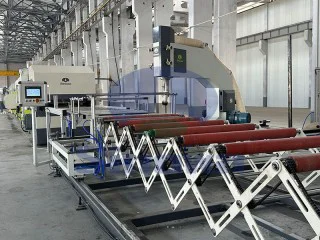
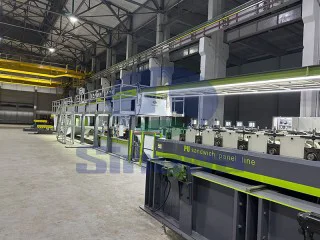


Main Technical Parameters of Sandwich Panel Machinery
- Production types: PU, PIR, phenolic, rockwool panels
- Production usage: insulation panels, decorative panels
- Sheet surface options: aluminum foil, non-woven fabric, paper, naked surface
- Product thickness: 10m -200 mm
- Production speed: 3.0m - 25m
- Foaming method: two or multi-component foaming
- Foaming agent: pentane or 141B
- Line length: 45m -100m, Customer Optional
Polyurethane sandwich panel production machinery is a set of continuous forming production equipment specially developed for manufacturing composite insulated panels with polyurethane as the core foam layer. It integrates raw material metering, chemical foaming, laminating, forming, cutting and conveying into one coordinated production line. This type of production facility turns flexible metal or non-metal surface sheets and liquid polyurethane raw materials into finished sandwich panels in a continuous automated flow. It has become a core production solution for the thermal insulation and enclosure material industry due to its stable forming performance and high production efficiency.
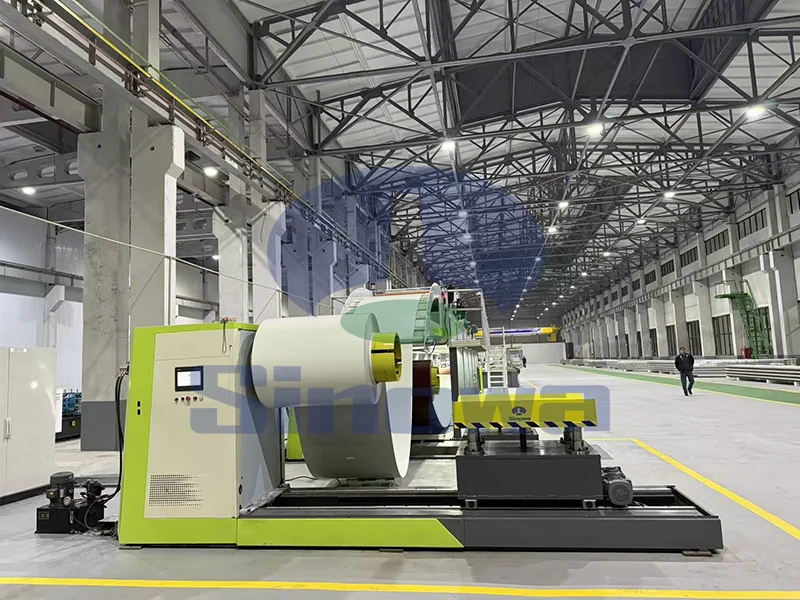
Working Principle
The core working logic of polyurethane sandwich panel manufacturing machinery relies on the chemical reaction of two-component polyurethane raw materials. After precise proportional mixing under a controlled environment, the mixed liquid material is evenly sprayed onto the lower surface sheet moving forward along the production line. The mixed polyurethane starts foaming and expanding rapidly, filling the space between the lower and upper facing sheets. Driven by the continuous traction system, the upper and lower surface layers are pressed tightly together with the rising foam inside in the double-belt forming section. Under constant pressure and suitable temperature conditions, polyurethane completes curing and solidification, forming a rigid foam core that bonds firmly with both facing materials. After solidification, the continuous slab is cut to preset lengths by the flying saw cutting unit, and finished panels are output after follow-up conveying and stacking. The whole reaction and forming process proceeds continuously without intermittent molding, which ensures consistent thickness, uniform foam density and reliable bonding strength of finished panels.
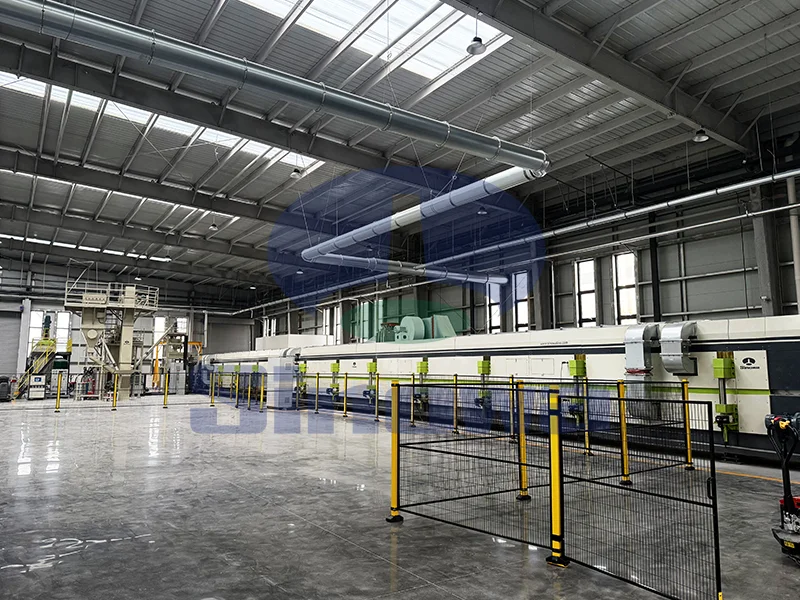
Main Components of the Whole Machine
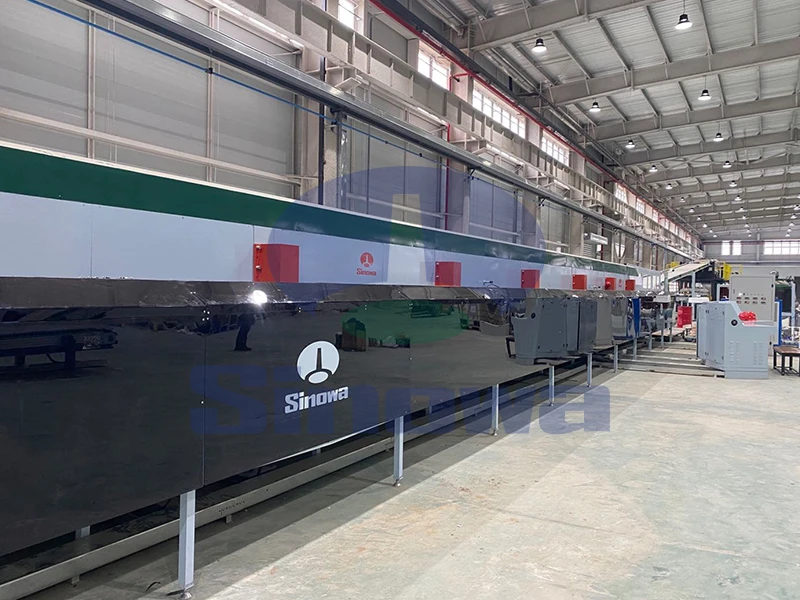
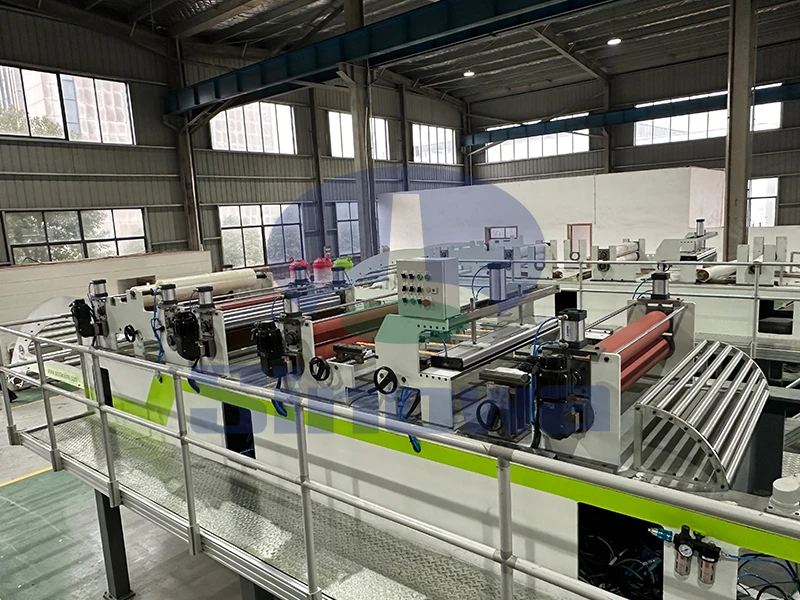
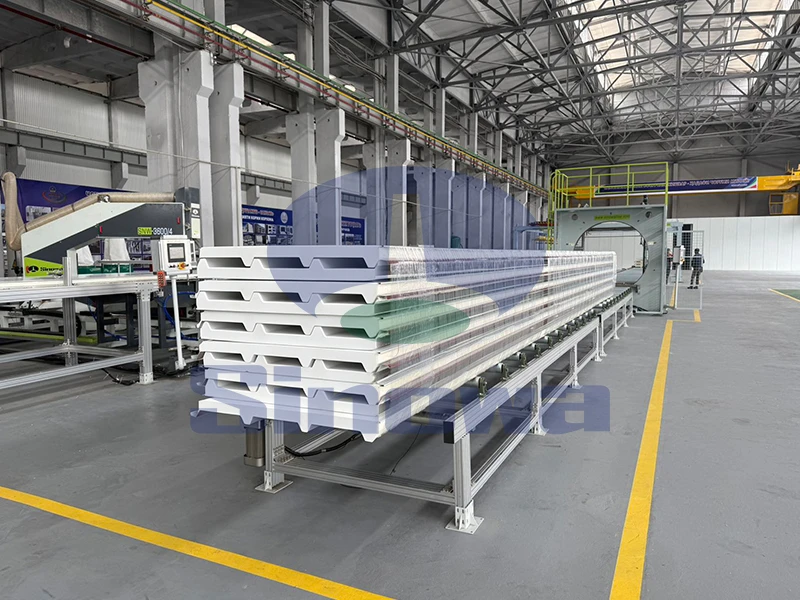
The complete polyurethane sandwich panel production line consists of multiple functional units that coordinate with each other. The raw material feeding and metering unit stores polyol and isocyanate separately and delivers materials at an accurately adjustable flow rate through metering pumps. The sheet unwinding unit releases coil raw materials for the upper and lower facings and carries out preliminary leveling and edge trimming. Next is the high-pressure foaming and spraying unit, which mixes two liquid components and sprays the mixture evenly on the bottom sheet. The double-belt forming machine provides stable clamping pressure and supporting surface for foaming and curing, controlling the panel thickness precisely. A traction unit provides stable forward power for the whole material belt and maintains consistent line speed. The flying saw cutting device cuts continuous long panels into specified sizes without stopping production. Follow-up parts include a finished panel conveyor, stacking device, waste collection mechanism and auxiliary heating system. All individual units are arranged in sequence and matched in running speed to realize continuous cyclic production.
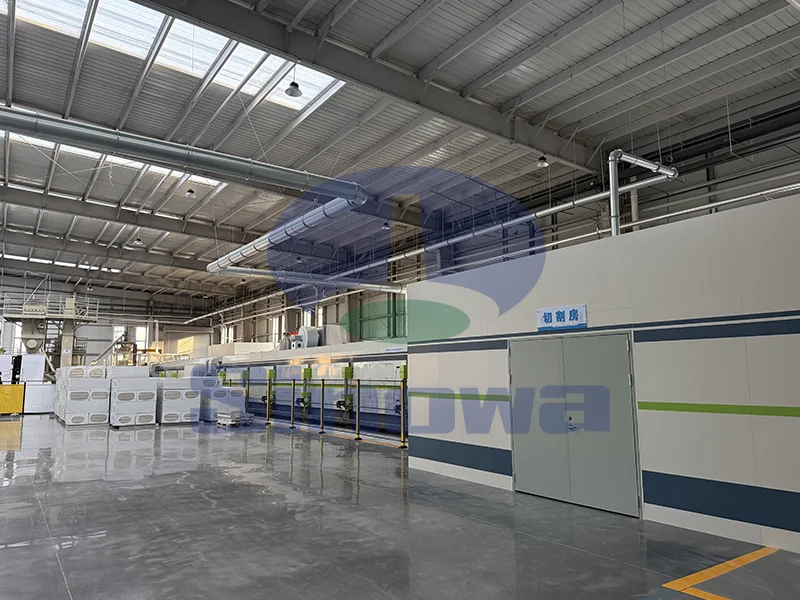
Production Process Flow
The production workflow follows a fixed continuous sequence. First, facing coils are installed on unwinding racks, and sheet materials are pulled out, leveled and guided to the forming track. Two polyurethane raw materials are transferred from storage tanks to the metering system, where flow parameters are set according to production requirements. Then the materials are conveyed to the mixing head for instantaneous mixing and uniform spraying on the moving lower sheet. The lower sheet with sprayed foam enters the double-belt area, and the upper facing sheet is closed and pressed together. Inside the forming section, polyurethane foams, expands and cures under constant pressure and temperature to form a bonded composite panel. After the foam is fully cured, the continuous panel moves forward to the cutting station, where the flying saw cuts it to the required length. Cut panels are conveyed out, manually or automatically stacked, inspected and packaged for storage and shipment. The whole process runs continuously, and each step’s operating parameters can be adjusted to adapt to different product specifications.

Available Panel Types and Application Scenarios
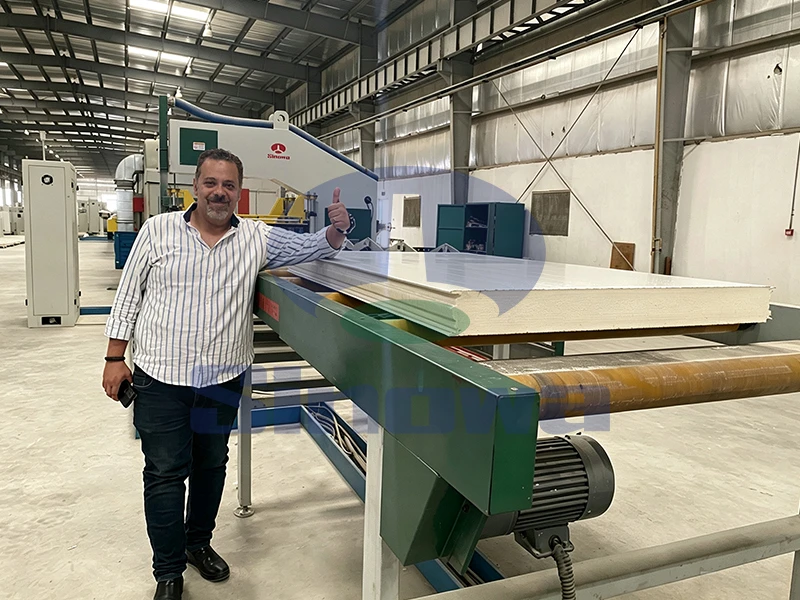
This machinery can produce a wide range of polyurethane sandwich panels by replacing different facing materials and adjusting process parameters. Common products include metal-faced polyurethane insulated panels with steel as the outer layer, panels with aluminum facings, and composite panels with non-metal facings such as fiber cement boards. It can also manufacture panels with different surface profiles, including flat panels and panels with embossed or corrugated outer surfaces. These finished panels have outstanding thermal insulation, sound insulation and structural performance. They are widely used as wall and roof enclosure materials for industrial workshops, cold storage warehouses and logistics storage buildings. They also serve as partition boards for clean rooms, temporary prefabricated building components, and enclosure materials for agricultural greenhouses. In addition, such panels can be applied for thermal insulation structures of special temporary facilities and modular building systems.
Advantages and Characteristics of the Equipment
Polyurethane sandwich panel making machinery has obvious advantages in continuous production. It supports long-time uninterrupted operation and achieves relatively high output compared with discontinuous batch molding equipment. The double-belt forming structure can maintain stable pressure during foaming, so the finished panels feature stable thickness and uniform foam texture. The foaming reaction is completed in a closed forming space, which effectively reduces material waste and keeps the production environment clean. The equipment has strong flexibility: users can adjust line speed, raw material ratio and forming clearance to switch among multiple panel specifications. The bonding between the foam core and facing materials is formed synchronously during foaming, which avoids additional adhesive procedures. The layout of the production line is compact, and the occupied workshop space is reasonably arranged. The wearing parts are easy to maintain and replace, and the overall operation cost is controllable under normal maintenance.
Control System and Quality Control
The production line is equipped with an integrated central control system. Operators set parameters such as material flow, line speed, forming temperature and cutting length on the human-machine interface. The system realizes synchronous linkage of the unwinding, metering, traction and cutting units to avoid speed mismatch. Real-time data of key operating parameters can be displayed on the control screen for operators to monitor the production status. For quality control, the metering system keeps track of raw material proportioning to prevent deviation of foam performance. The forming clearance is locked to guarantee consistent panel thickness. During production, workers conduct periodic sampling checks on the appearance, surface flatness and cutting dimension of panels. Abnormal signals such as material shortage, pressure fluctuation and temperature deviation will trigger prompt reminders, so operators can make timely adjustments before defective products are produced.
Installation, Matching and After-sales Service
Before installation, the site needs a flat and solid foundation with reserved space for the whole line layout, as well as supporting power supply and ventilation facilities. Technical guidance will be provided for equipment positioning, leveling, connection of pipelines and debugging of the linkage system after the equipment arrives. Supporting auxiliary facilities include raw material storage tanks, compressed air supply equipment and waste treatment devices. After commissioning, technical personnel will conduct operation training for on-site operators, covering parameter adjustment, routine inspection and standard shutdown procedures. For after-sales support, long-term technical consultation is available for operational problems in the production process. Guidance on regular maintenance plans and replacement cycles of vulnerable parts will be supplied. Remote technical assistance can be provided to diagnose common running faults. When necessary, professional service support will be arranged to solve complex equipment failures and help users maintain stable production of sandwich panels.
Conclusion
As a continuous automated production system, polyurethane sandwich panel machinery realizes efficient manufacturing of composite insulated panels through coordinated control of raw material reaction, continuous forming and fixed-length cutting. Relying on adjustable production parameters and flexible configuration, it can produce diversified sandwich panels for various construction and insulation scenarios. With reliable control logic and complete supporting service arrangements, this equipment remains a practical production option for enterprises engaged in insulated enclosure material manufacturing. With the continuous development of modular construction and thermal insulation demand, this type of forming equipment will keep evolving to match the diversified production needs of the market.
- Continuous PU Sandwich Panel Line
- Glass Wool Sandwich Panel Production Line
- Insulation Board Production Line
- Mineral Wool Sandwich Panel Production Line
- PIR Sandwich Panel Production Line
- Polyurethane Sandwich Panel Line
- Polyurethane Sandwich Panel Machine
- Polyurethane Sandwich Panel Manufacturing Line
- Polyurethane Sandwich Panel Production Line
- PU Sandwich Panel Line
- PU Sandwich Panel Machine
- PU Sandwich Panel Production Line
- PUR Sandwich Panel Production Line
- Rock Wool Sandwich Panel Production Line
- Sandwich Panel Lines
- Sandwich Panel Machines
- Sandwich Panel Manufacturing Line
- Sandwich Panel Production Line
- Sandwich Panel Production Machinery
- Sandwich Panel Production Machines