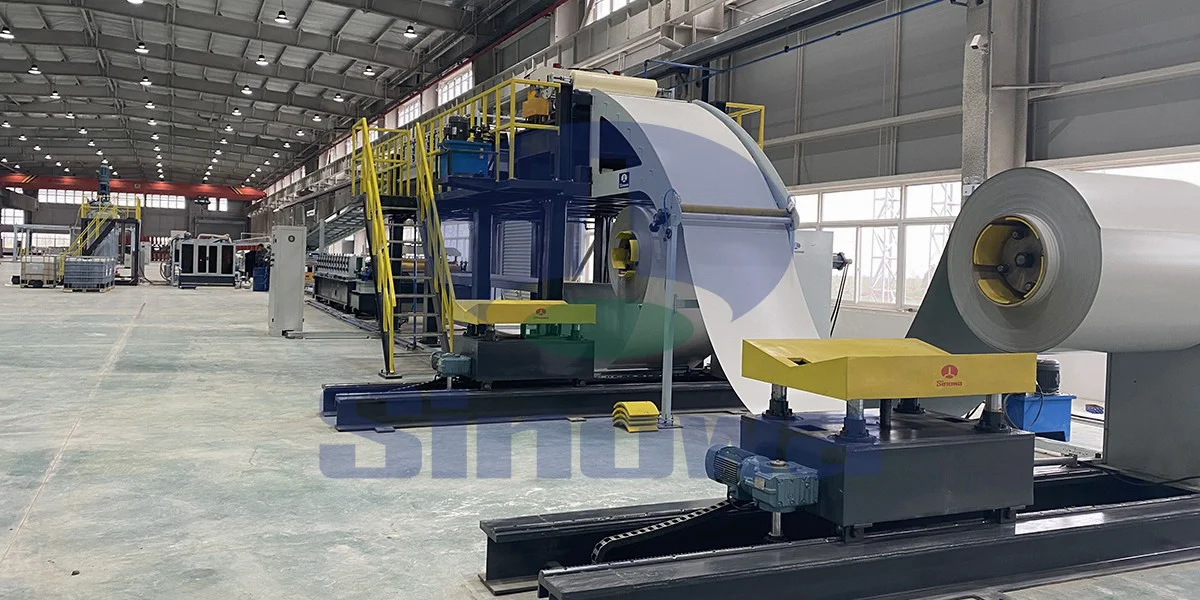
Insulation Sandwich Panel Equipment
Insulation sandwich panel equipment for PU, PIR, rock wool, mineral wool, phenolic & glass wool. Continuous automatic line with centralized control, stable bonding & flexible switching for cold room, workshop & prefab building panels.
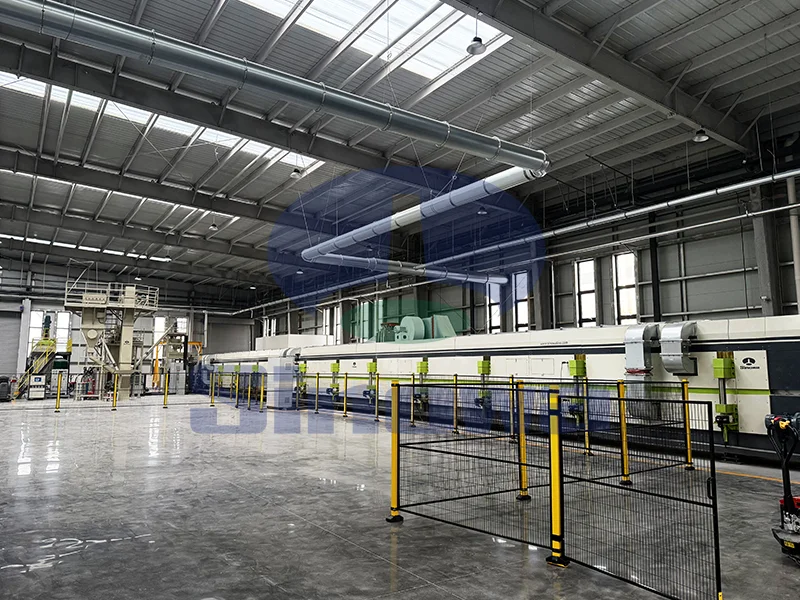
Overview of Sandwich Panel Plants
This insulation sandwich panel equipment supports PU, PIR, rock wool, mineral wool, phenolic foam and glass wool cores. It works via continuous composite molding, consisting of unwinding, forming, feeding, pressing, cutting and stacking units. After core laying, pressing and curing, finished panels for cold storage, workshops and prefab buildings are produced. Featuring flexible material switching and centralized control, it ensures stable panel quality. It also includes on-site installation guidance, operator training and long-term after-sales support.
Sinowa insulation sandwich panel equipment reaches world-class standards in equipment efficiency, automatic control, HMI, environmental protection and energy-saving performance. It adopts disruptive key technologies and delivers excellent cost-performance, supporting remote interactive communication.
-
![Insulation Sandwich Panel Equipment]() Modular Design: The insulation sandwich panel equipment features modular design with freely combinable and interchangeable components. Core parts are machined by machining centers to minimize human-factor interference. It achieves high production efficiency and fast delivery with low maintenance loss. The sandwich panel equipment owns more than 40 innovative patented technologies.
-
![Insulation Sandwich Panel Equipment]() Multi-product Manufacturing Capacity: It can automatically produce roof, wall and cold-storage sandwich panels via configuration switching. It supports sandwich panels with core materials including PU, PIR, rock wool and glass wool. Custom configurations and flexible pricing packages are available upon customer requirements.
-
![Insulation Sandwich Panel Equipment]() Control System Advantages: Highly integrated and linked control system centralizes all control points on the main console. Functions including parameter linkage, full-line fault self-diagnosis, conveying distance control and remote communication are available to greatly cut manpower input.
-
![Insulation Sandwich Panel Equipment]() Main Machine Features: The main engine adopts a precision servo hoisting mechanism without hydraulic system. Board thickness can be adjusted flexibly and conveniently, avoiding common troubles of hydraulic systems such as leakage, commissioning and maintenance, ensuring precise operation and stable product quality.
-
![Insulation Sandwich Panel Equipment]() Energy-saving & Environmental-friendly Performance: Equipped with an independent heating-insulation room and brand-new fully-sealed inner insulation structure. It supports round-the-clock production all year round. The insulation system can heat up from ambient temperature above 5℃ to process temperature within less than one hour. Its energy consumption is only 40% of similar products, which greatly reduces production costs.
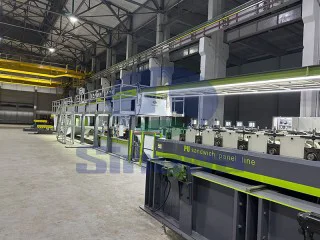


Main Technical Parameters of Sandwich Panel Machinery
- Production types: PU, PIR, phenolic, rockwool panels
- Production usage: insulation panels, decorative panels
- Sheet surface options: aluminum foil, non-woven fabric, paper, naked surface
- Product thickness: 10m -200 mm
- Production speed: 3.0m - 25m
- Foaming method: two or multi-component foaming
- Foaming agent: pentane or 141B
- Line length: 45m -100m, Customer Optional
Insulation sandwich panel equipment refers to a set of continuous or semi-continuous production machinery specially developed for manufacturing composite insulation sandwich panels with different core materials. It supports multiple core substrates including polyurethane (PU), polyisocyanurate (PIR), rock wool, mineral wool, phenolic foam and glass wool. This type of production line integrates continuous feeding, forming, compounding, curing, cutting and stacking functions, and turns metal facings and thermal insulation core materials into finished sandwich panels in an automated flow. The diversified material compatibility enables the equipment to adapt to the growing market demands for thermal insulation, fire resistance and sound insulation of building enclosure systems.
Working Principle
The core working logic of the insulation sandwich panel equipment is continuous composite molding. Two layers of metal or non-metal surface facings are unwound and guided into the forming section, where the facings are calibrated and shaped into the required panel profile. For foam core materials such as PU, PIR and phenolic foam, raw chemical components are metered, mixed and sprayed or poured evenly between the upper and lower facings; chemical cross-linking reaction occurs inside the material to complete foaming and self-adhesion with facings. For fibrous core materials including rock wool, mineral wool and glass wool, prefabricated core strips or core blocks are automatically arranged and positioned between the two facings, and adhesive is applied to realize reliable bonding between the core layer and surface sheets. After compounding, the whole composite blank enters the double-belt pressing section, where constant pressure and temperature are maintained to guarantee stable bonding and curing. Once curing is finished, continuous panels are conveyed to the cutting unit to be segmented into specified lengths, followed by trimming and stacking.
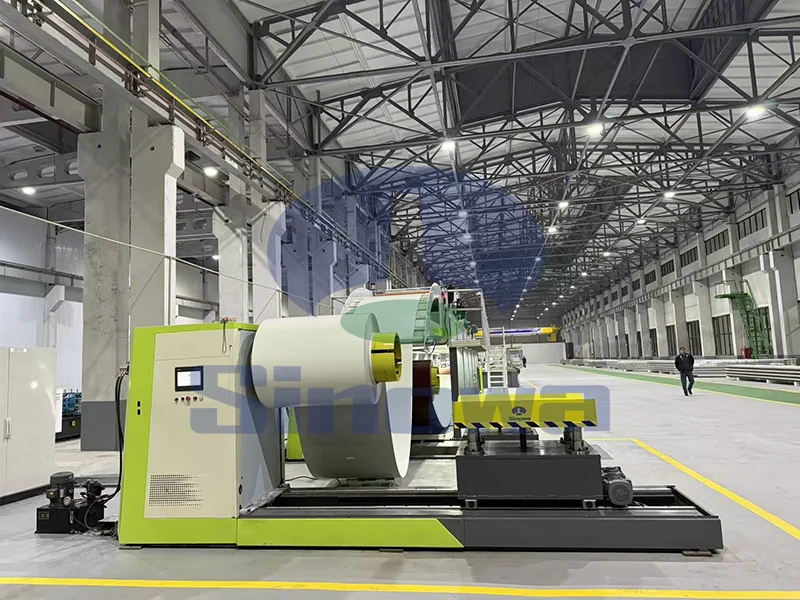
Main Components of the Whole Machine
The complete production line consists of several functional modules that work in coordination. The unwinding unit holds surface facing coils and delivers raw facings with adjustable tension to avoid wrinkling or deviation. The roll forming unit shapes flat facings into ribbed or flat profiles according to panel design requirements. The core material feeding system adopts different structures for foam and fibrous cores: a high-pressure foaming metering and mixing station for foamed materials, and a core wool conveying, arranging and positioning mechanism for rock wool, mineral wool and glass wool. The double-belt continuous press is the key host section, which provides stable clamping pressure and controllable curing temperature. The cutting unit includes flying saw or fixed cutting devices for length cutting without stopping the line. Auxiliary mechanisms cover edge trimming, waste collection, panel conveying, automatic stacking and finished product discharging platforms. Supporting auxiliary facilities contain material circulation pipelines, cleaning assemblies and safety protection covers for all moving parts.
Production Process Flow
The standardized production flow starts with coil loading and facing unwinding. Surface facings pass through tension adjustment and roll forming to form the outer skins of sandwich panels. Next is core material distribution: foaming raw materials are proportioned and mixed before being applied between facings, while fibrous wool cores are transported, aligned and laid in place. The upper and lower facings with the sandwiched core layer enter the continuous press for pressure holding and curing, during which bonding and material shaping are completed. The continuous composite slab moves forward at a set line speed and goes through surface inspection. When reaching the preset length, the cutting system automatically triggers cutting. Afterwards, side edge trimming removes irregular edges, and finished panels are conveyed to the stacking station. After stacking is completed, panel bundles are transferred out for subsequent packaging. The whole flow runs sequentially, and switching between different core materials can be realized by adjusting feeding parameters and replacing partial auxiliary fixtures.

Available Panel Types and Application Scenarios
Supported finished panels cover PU sandwich panels, PIR sandwich panels, rock wool sandwich panels, mineral wool sandwich panels, phenolic foam sandwich panels and glass wool sandwich panels. Each panel type carries distinctive functional properties to match different usage environments. PU and PIR panels feature excellent thermal insulation performance and lightweight structure, widely used for cold storage enclosures, temperature-controlled warehouses and cleanroom partitions. Rock wool and mineral wool panels highlight fire retardant and sound absorption performance, suitable for exterior wall cladding, partition walls of industrial workshops and public building roof systems. Phenolic foam panels balance low thermal conductivity and fire performance, preferred for ventilation duct wrapping and special insulation compartments. Glass wool sandwich panels deliver outstanding sound insulation together with heat preservation effects, commonly adopted for noise reduction structures of equipment rooms and interior partition systems of entertainment venues. All these panels can serve as roof, wall and partition components for prefabricated buildings, industrial plants, logistics parks and modular temporary buildings.
Advantages and Characteristics of the Equipment
This multi-core compatible sandwich panel production line possesses prominent flexible production advantages. Instead of being limited to a single core material, it can switch production among six types of insulation cores after simple parameter adjustment and partial accessory replacement, helping users enrich product portfolios with one set of equipment. The continuous pressing structure ensures consistent flatness and uniform bonding strength of finished panels, reducing the rate of hollow bonding and delamination. The line speed can be adjusted within a reasonable range to balance production capacity and product quality. The mechanical layout optimizes material utilization and lessens leftover waste. The equipment frame is designed with high structural rigidity to sustain long-hour continuous operation. Humanized safety isolation design reduces operational risks, and the modular layout facilitates daily inspection and component maintenance. Compared with separated semi-automatic equipment, this integrated line cuts down intermediate handling procedures and improves overall production efficiency.
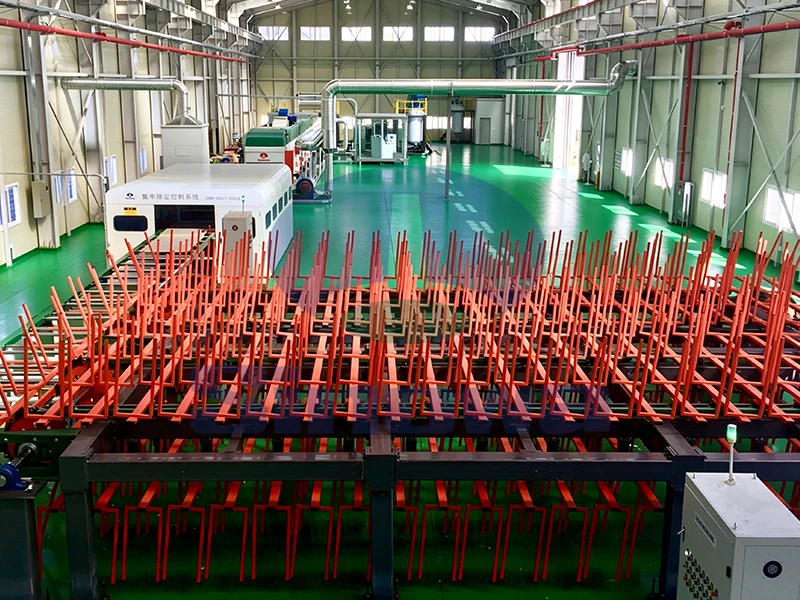
Control System and Quality Control
The whole line is equipped with an integrated centralized control system. Operators set parameters such as line speed, pressing temperature, clamping pressure, cutting length and material feeding volume on the human-machine interface. Real-time operating data of each unit is displayed on the screen, and abnormal signals will trigger prompt alarms. For foamed core materials, the system precisely controls the ratio, flow rate and mixing temperature of chemical raw materials to stabilize foaming density. For wool core panels, the positioning system monitors core material arrangement deviation to prevent offset of the insulation layer. During production, online inspection tracks surface flatness, bonding continuity and panel dimension. Sampling checks on finished products cover core thickness, overall panel thickness and surface appearance. All key running parameters can be stored for production traceability, helping operators adjust processes timely when quality fluctuation occurs.
Supporting Installation and After-sales Service
Before commissioning, professional technical guidance is provided for site layout planning, foundation construction, power supply and auxiliary pipeline matching. After the equipment arrives at the site, technical personnel guide the assembly, alignment, connection and integrated debugging of each module, and carry out trial production runs to verify the operation status of the whole line. Basic operation and routine maintenance training are delivered to on-site operators, covering parameter adjustment, regular lubrication, wearing part replacement and common fault judgment. The after-sales support channel keeps accessible for technical consultation after formal production starts. Guidance for troubleshooting is available remotely; for complicated malfunctions, on-site service can be arranged. Supply channels of wearing spare parts are supported to ensure long-term stable operation of the production line. Regular maintenance reminders are provided to extend the service life of mechanical and electrical components.

Conclusion
Multi-material insulation sandwich panel equipment represents a flexible and integrated production solution for composite insulation panels. By supporting PU, PIR, rock wool, mineral wool, phenolic foam and glass wool core materials, it connects raw material processing with finished panel forming through continuous automated workflows. Its stable pressing structure, adjustable control system and diversified product output capacity satisfy the broad requirements of thermal insulation, fire prevention and sound insulation in modern construction. With proper installation, standardized operation and reliable after-sales support, the equipment can continuously produce high-performance sandwich panels and deliver stable benefits for insulation panel manufacturers.
- Continuous PU Sandwich Panel Line
- Glass Wool Sandwich Panel Production Line
- Insulation Board Production Line
- Mineral Wool Sandwich Panel Production Line
- PIR Sandwich Panel Production Line
- Polyurethane Sandwich Panel Line
- Polyurethane Sandwich Panel Machine
- Polyurethane Sandwich Panel Manufacturing Line
- Polyurethane Sandwich Panel Production Line
- PU Sandwich Panel Line
- PU Sandwich Panel Machine
- PU Sandwich Panel Production Line
- PUR Sandwich Panel Production Line
- Rock Wool Sandwich Panel Production Line
- Sandwich Panel Lines
- Sandwich Panel Machines
- Sandwich Panel Manufacturing Line
- Sandwich Panel Production Line
- Sandwich Panel Production Machinery
- Sandwich Panel Production Machines