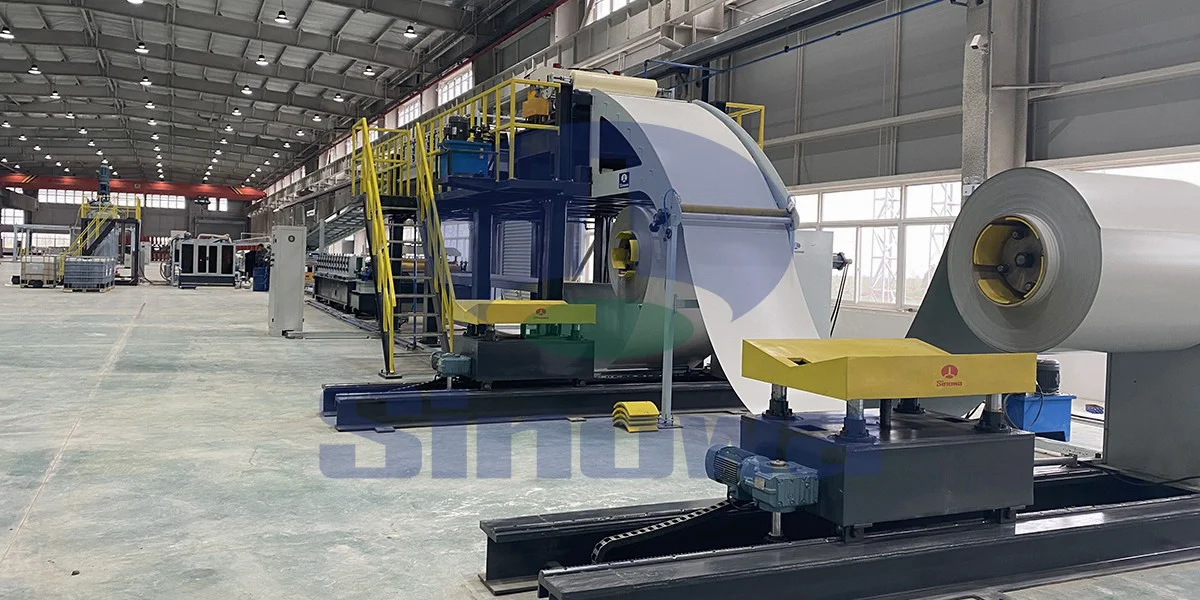
Wall Panel Production Line
Fully automatic wall panel production line for sandwich panels. High output, stable quality, custom sizes & turnkey solution. Professional manufacturer in China.

Overview of Sandwich Panel Plants
This versatile wall panel production line works with polyurethane, PIR, rock wool, mineral wool, phenolic foam and glass wool. It adopts a continuous forming workflow covering feeding, laminating, pressing, curing and trimming. Adjustable settings support custom panel sizes and varied surface finishes. Centralised control stabilises quality by tuning temperature, pressure and speed for different core materials. Optimised layout improves efficiency and cuts waste. Finished panels offer insulation and sound insulation, fitting modular construction for various building applications.
Sinowa wall panel production line reaches world-class standards in equipment efficiency, automatic control, HMI, environmental protection and energy-saving performance. It adopts disruptive key technologies and delivers excellent cost-performance, supporting remote interactive communication.
-
![Wall Panel Production Line]() Modular Design: The wall panel production line features modular design with freely combinable and interchangeable components. Core parts are machined by machining centers to minimize human-factor interference. It achieves high production efficiency and fast delivery with low maintenance loss. The sandwich panel equipment owns more than 40 innovative patented technologies.
-
![Wall Panel Production Line]() Multi-product Manufacturing Capacity: It can automatically produce roof, wall and cold-storage sandwich panels via configuration switching. It supports sandwich panels with core materials including PU, PIR, rock wool and glass wool. Custom configurations and flexible pricing packages are available upon customer requirements.
-
![Wall Panel Production Line]() Control System Advantages: Highly integrated and linked control system centralizes all control points on the main console. Functions including parameter linkage, full-line fault self-diagnosis, conveying distance control and remote communication are available to greatly cut manpower input.
-
![Wall Panel Production Line]() Main Machine Features: The main engine adopts a precision servo hoisting mechanism without hydraulic system. Board thickness can be adjusted flexibly and conveniently, avoiding common troubles of hydraulic systems such as leakage, commissioning and maintenance, ensuring precise operation and stable product quality.
-
![Wall Panel Production Line]() Energy-saving & Environmental-friendly Performance: Equipped with an independent heating-insulation room and brand-new fully-sealed inner insulation structure. It supports round-the-clock production all year round. The insulation system can heat up from ambient temperature above 5℃ to process temperature within less than one hour. Its energy consumption is only 40% of similar products, which greatly reduces production costs.
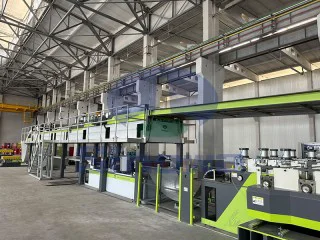
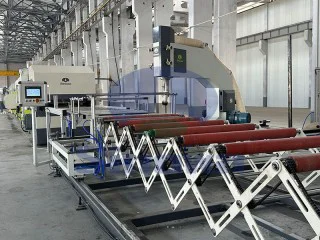
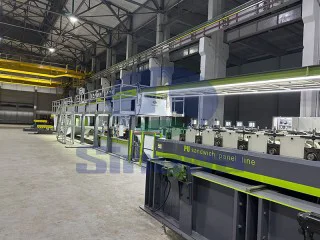


Main Technical Parameters of Sandwich Panel Machinery
- Production types: PU, PIR, phenolic, rockwool panels
- Production usage: insulation panels, decorative panels
- Sheet surface options: aluminum foil, non-woven fabric, paper, naked surface
- Product thickness: 10m -200 mm
- Production speed: 3.0m - 25m
- Foaming method: two or multi-component foaming
- Foaming agent: pentane or 141B
- Line length: 45m -100m, Customer Optional
Broad Material Compatibility of the Production System
A modern wall panel production line is engineered to process a wide spectrum of insulation core materials, covering polyurethane, PIR, rock wool, mineral wool, phenolic foam and glass wool. Each core material carries distinct thermal and physical traits, and the line is designed with adjustable modules to accommodate differences in density, rigidity and fibre structure. The flexible setup allows operators to switch between material types after simple parameter tuning, without major reconstruction of the main equipment framework. This adaptability makes the line suitable for producing composite panels tailored to diverse application scenarios in building enclosure systems.
Continuous Forming Workflow for Stable Panel Structure
The production process follows a continuous forming principle to bond surface facings and insulation cores into integrated wall panels. Material feeding, core laying, glue spreading, pressing, curing and trimming proceed in a sequential, synchronised flow along the line. Precision-controlled conveying speed ensures uniform thickness and consistent bonding across the full length of finished panels. For foam-based cores such as polyurethane and PIR, on-site foaming and reaction take place within the confined pressing zone, while fibrous materials like rock wool and glass wool are pre-shaped before lamination. Synchronisation between every unit eliminates gaps, delamination and uneven surface defects.
Customisable Panel Dimensions and Surface Options
Adjustable mechanical components enable the line to deliver wall panels in varied widths, thicknesses and lengths according to project requirements. Surface layers can be selected from different sheet types to match aesthetic and performance needs, forming smooth, textured or profiled outer faces. The cutting station processes continuous panel strips into finished units of preset sizes, with clean and straight edges ready for subsequent handling. No fixed dimension template restricts output, so the same line can produce slim interior partition panels and heavy-duty exterior wall components as required.
Process Control for Consistent Product Quality
Centralised process regulation manages key variables throughout the manufacturing cycle, including feeding volume, bonding pressure, curing time and temperature conditions. Operators monitor real-time running status and fine-tune settings when shifting between core materials. For phenolic and foam cores, thermal parameters are closely managed to maintain stable chemical reaction results; for fibrous wool cores, compression pressure is calibrated to preserve the original insulation performance without crushing internal fibre structures. Standardised control logic reduces manual errors and keeps batch-to-batch product performance steady.
Operational Efficiency and Resource Management
Well-integrated layout of the wall panel production line cuts redundant transfer steps between separate processing stations, lifting overall output efficiency. Material waste is controlled through precise metering and positioning systems, which reduce excess adhesive and leftover core scraps during cutting. The equipment layout also considers routine maintenance access, so worn consumable parts can be replaced quickly with minimal downtime. Reasonable energy matching for heating, pressing and driving units helps optimise resource consumption during long-running production shifts.
Application Value of Multi-material Wall Panel Output
Panels made on this production line serve multiple building functional zones, balancing thermal insulation, sound attenuation and structural enclosure demands. Polyurethane and PIR panels stand out for high thermal efficiency, while rock wool, mineral wool and glass wool options deliver reliable fibre-based insulation properties. Phenolic foam panels bring unique performance characteristics suited for specific building environments. The diverse finished products support modular construction methods, helping speed up on-site assembly and simplify the wall installation process for different building projects.
- Continuous PU Sandwich Panel Line
- Glass Wool Sandwich Panel Production Line
- Insulation Board Production Line
- Mineral Wool Sandwich Panel Production Line
- PIR Sandwich Panel Production Line
- Polyurethane Sandwich Panel Line
- Polyurethane Sandwich Panel Machine
- Polyurethane Sandwich Panel Manufacturing Line
- Polyurethane Sandwich Panel Production Line
- PU Sandwich Panel Line
- PU Sandwich Panel Machine
- PU Sandwich Panel Production Line
- PUR Sandwich Panel Production Line
- Rock Wool Sandwich Panel Production Line
- Sandwich Panel Lines
- Sandwich Panel Machines
- Sandwich Panel Manufacturing Line
- Sandwich Panel Production Line
- Sandwich Panel Production Machinery
- Sandwich Panel Production Machines