
Phenolic Sandwich Panel Production Line
Phenolic Sandwich Panel Production Line from professional manufacturer. Integrated foaming, laminating & cutting system. Reliable running, easy operation, long service life. Suitable for mass production of phenolic insulation sandwich panels.
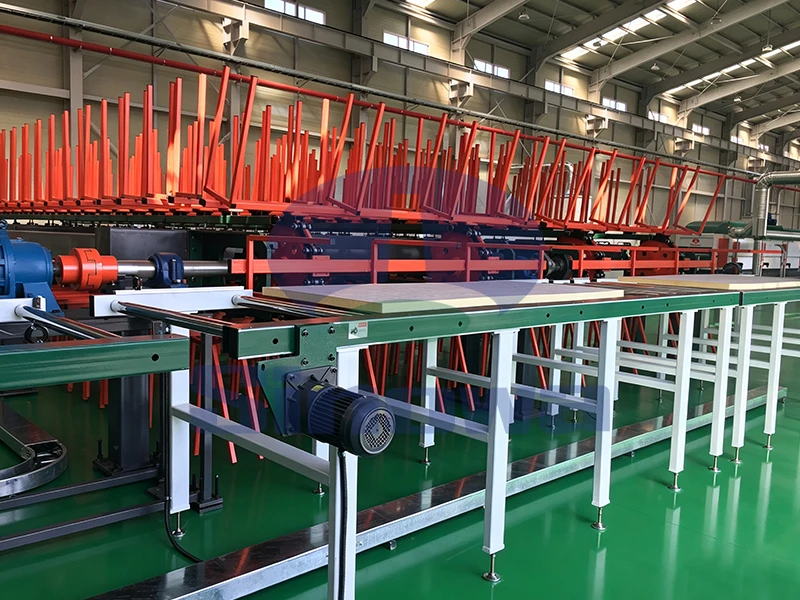
Overview of Sandwich Panel Plants
This phenolic sandwich panel production line is an automated continuous system for composite board manufacturing. It works via in-situ foaming and curing of phenolic resin between two surface facings under controlled temperature and pressure. Consisting of feeding, mixing, double-belt curing, trimming, cutting and stacking modules, it follows a streamlined workflow to produce panels with various facings. The line features flexible specification adjustment and stable forming. Equipped with a linked control system and full-process quality checks, it supplies insulation panels widely used in buildings, cleanrooms and prefabricated structures, with professional installation and after-sales support.
Sinowa phenolic sandwich panel production line reaches world-class standards in equipment efficiency, automatic control, HMI, environmental protection and energy-saving performance. It adopts disruptive key technologies and delivers excellent cost-performance, supporting remote interactive communication.
-
![Phenolic Sandwich Panel Production Line]() Modular Design: The phenolic sandwich panel production line features modular design with freely combinable and interchangeable components. Core parts are machined by machining centers to minimize human-factor interference. It achieves high production efficiency and fast delivery with low maintenance loss. The sandwich panel equipment owns more than 40 innovative patented technologies.
-
![Phenolic Sandwich Panel Production Line]() Multi-product Manufacturing Capacity: It can automatically produce roof, wall and cold-storage sandwich panels via configuration switching. It supports sandwich panels with core materials including PU, PIR, rock wool and glass wool. Custom configurations and flexible pricing packages are available upon customer requirements.
-
![Phenolic Sandwich Panel Production Line]() Control System Advantages: Highly integrated and linked control system centralizes all control points on the main console. Functions including parameter linkage, full-line fault self-diagnosis, conveying distance control and remote communication are available to greatly cut manpower input.
-
![Phenolic Sandwich Panel Production Line]() Main Machine Features: The main engine adopts a precision servo hoisting mechanism without hydraulic system. Board thickness can be adjusted flexibly and conveniently, avoiding common troubles of hydraulic systems such as leakage, commissioning and maintenance, ensuring precise operation and stable product quality.
-
![Phenolic Sandwich Panel Production Line]() Energy-saving & Environmental-friendly Performance: Equipped with an independent heating-insulation room and brand-new fully-sealed inner insulation structure. It supports round-the-clock production all year round. The insulation system can heat up from ambient temperature above 5℃ to process temperature within less than one hour. Its energy consumption is only 40% of similar products, which greatly reduces production costs.
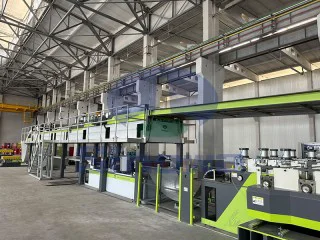
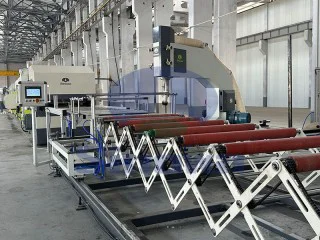
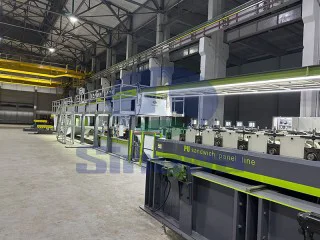


Main Technical Parameters of Sandwich Panel Machinery
- Production types: PU, PIR, phenolic, rockwool panels
- Production usage: insulation panels, decorative panels
- Sheet surface options: aluminum foil, non-woven fabric, paper, naked surface
- Product thickness: 10m -200 mm
- Production speed: 3.0m - 25m
- Foaming method: two or multi-component foaming
- Foaming agent: pentane or 141B
- Line length: 45m -100m, Customer Optional
A phenolic sandwich panel production line is a continuous automated manufacturing system designed for the integrated forming of composite panels with phenolic foam cores. It combines continuous foaming, surface material lamination, curing, trimming and cutting into one coordinated production process. The finished phenolic sandwich panels are widely recognised for stable thermal insulation performance and favourable fire resistance properties. This production setup streamlines the conversion of raw chemical materials and surface facings into finished composite boards with consistent structural integrity.
Working Principle
The core working logic of this production line relies on the in-situ foaming and curing reaction of phenolic resin raw materials. After metering and mixing, the phenolic composite raw materials are evenly distributed between two layers of continuous surface facings. Under controlled temperature and pressure inside the double-belt conveyor, the mixed material undergoes foaming, cross-linking and solidification to form a closed-cell phenolic foam core. The foam core bonds tightly with the upper and lower facings during the curing phase, forming an integrated sandwich structure. Continuous forward movement of the double belt maintains uniform pressure and reaction conditions across the panel width and length, so that foaming density, bonding strength and panel thickness stay stable throughout the continuous production run. After full curing, the continuous panel is conveyed to subsequent stations for shaping and sizing.
Main Components of the Whole Machine
The production line consists of multiple functional modules that operate in sync. The raw material feeding and metering unit precisely delivers phenolic resin, curing agents and auxiliary additives into the mixing system. The continuous surface material unwinding unit releases upper and lower facings such as metal sheets, fibre fabrics or other decorative substrates at a steady speed. The high-speed mixing and pouring unit blends liquid raw components uniformly and spreads the mixture onto the lower facing. The double-belt pressing and curing section is the key forming unit, providing constant clamping pressure and adjustable thermal environment for foaming and curing.
Following the curing zone, the edge trimming unit removes irregular side margins to guarantee consistent panel width. The longitudinal cutting and transverse sawing unit cuts the endless continuous panel into preset finished lengths. Auxiliary structures include a conveying and turnover system, waste collection mechanism and finished panel stacking device. All individual modules are matched in running speed to avoid material stretching, uneven foaming or delamination between core and facings.
Production Process Flow
The complete production sequence follows a fixed continuous workflow. First, raw liquid materials are loaded into independent storage tanks, and surface facings are installed on unwinding racks. The system starts up and synchronises the running speed of all stations. Liquid phenolic components are metered proportionally and sent to the mixing head, then poured evenly on the moving lower facing. The upper facing closes over the poured mixture, and the composite enters the double-belt curing tunnel.
Foaming and cross-linking reactions take place inside the tunnel under set pressure and temperature. Once the phenolic core is fully cured and bonded with facings, the continuous slab exits the curing section. Side trimming removes rough edges, and surface inspection checks for visible defects. The continuous slab is then cut to required dimensions by transverse sawing. Finished panels are conveyed to the stacking area, and leftover trimmings are collected separately. The whole process runs continuously without frequent interruption under normal operating conditions.
Available Panel Types and Application Scenarios
This production line supports the manufacturing of phenolic sandwich panels with different facing combinations. Common types include panels with thin metal facings, fibre-reinforced facings and flexible decorative facings. It can produce panels with varied core thicknesses and surface treatments according to structural requirements.
These phenolic sandwich panels serve a wide range of application scenarios. They are used for building exterior and interior thermal insulation enclosure systems, partition walls inside commercial buildings, cleanroom wall and ceiling systems, as well as ventilation duct lining materials. They are also adopted for cold storage insulation structures and temporary prefabricated building envelopes. Thanks to the inherent characteristics of phenolic foam, the panels fit projects that require both heat preservation and reliable fire performance.
Equipment Advantages and Features
This continuous phenolic sandwich panel production line features high automation and stable continuous output capacity. The double-belt forming structure ensures uniform panel thickness and consistent core density across the whole board surface, effectively reducing the risk of voids, cracking or uneven bonding. The material pouring system achieves even distribution of the phenolic mixture, which helps avoid local over-foaming or insufficient foaming.
The line supports flexible adjustment of production speed, panel thickness and raw material formula, so it can switch between different product specifications without major reconstruction. The integrated layout reduces manual intervention in core forming procedures. The sealing structure of the curing zone lowers heat loss and improves energy utilisation during the foaming and curing reaction. In addition, the trimming and cutting mechanism delivers neat panel edges, reducing later secondary processing workload.
Control System and Quality Control
The production line is equipped with an integrated central control system. Operators set parameters such as material ratio, line speed, curing temperature and pressing pressure on the control interface. Real-time data of each key station is displayed on the operation terminal, and abnormal parameter fluctuations trigger prompt alerts. Synchronisation of unwinding, pouring, pressing and cutting is maintained by the linkage control program to prevent asynchronous operation.
Quality control runs through the whole manufacturing process. Raw material feeding parameters are monitored continuously to keep the mixing ratio stable. During forming, pressure and temperature inside the curing tunnel are maintained within the target range. After forming, online visual inspection checks surface flatness, bonding condition and apparent defects. Sampling inspection is carried out periodically to verify core density, bonding effect and dimensional accuracy of finished panels. Non-conforming products are separated at the inspection station to prevent defective panels from entering the finished product stack.
Supporting Installation and After-sales Service
Before installation, technical personnel provide layout planning according to the workshop space, including reserved space for raw material storage, line operation and finished product turnover. The installation work includes mechanical assembly, pipeline connection of the raw material system, wiring of the control circuit and debugging of the linkage of each unit. After mechanical installation, a trial run with raw materials is conducted to adjust parameters and verify the coordination of all stations.
For after-sales support, technical guidance is provided for daily operation, routine maintenance and common fault troubleshooting. Operation training covers standard startup and shutdown procedures, parameter adjustment methods and daily maintenance points for wearing parts. Remote technical support is available to analyse abnormal operation conditions. Spare part consultation and maintenance guidance are supplied for long-term stable running of the line. Regular maintenance reminders help users extend the service life of mechanical and control components.
- Continuous PU Sandwich Panel Line
- Glass Wool Sandwich Panel Production Line
- Insulation Board Production Line
- Mineral Wool Sandwich Panel Production Line
- PIR Sandwich Panel Production Line
- Polyurethane Sandwich Panel Line
- Polyurethane Sandwich Panel Machine
- Polyurethane Sandwich Panel Manufacturing Line
- Polyurethane Sandwich Panel Production Line
- PU Sandwich Panel Line
- PU Sandwich Panel Machine
- PU Sandwich Panel Production Line
- PUR Sandwich Panel Production Line
- Rock Wool Sandwich Panel Production Line
- Sandwich Panel Lines
- Sandwich Panel Machines
- Sandwich Panel Manufacturing Line
- Sandwich Panel Production Line
- Sandwich Panel Production Machinery
- Sandwich Panel Production Machines